How The Future Was Then
Comics portrayal of the future
How we have viewed the future has changed with time.
This is evidenced in the way comics have portrayed the future
as was seen at London's Cartoon Museum special 2026 exhibition,
as Jonathan (words) and Julie (pictures) found out.
Science Fiction evolves with time and the SF encyclopaedist, John Clute, is noted for saying that it is usually possible to estimate when an SF work was created. So, with London's Cartoon Museum held an exhibition on how comics have portrayed the future, we simply had to see what was on offer.
The Cartoon Museum is London's museum for British cartoons, caricatures and comic strips, owned and operated by the Cartoon Art Trust charity. The museum issues catalogues and features a changing display of over 250 exhibits from its collection of over 4,000 original cartoons and prints. The museum is dedicated to preserving the best of British cartoons, caricatures, comics and animation, and to provide exhibits. Since 2019 it is located a little to the north of London's West End in the shadow of the Post Office Tower. Visitors not only get a ticket for the day, that ticket is effectively membership of the museum entitling folk to revisit for free for a year.
Outside of the special science fiction exhibits, the museum mainly focuses on cartoons and some of the best ones have political and social bite.
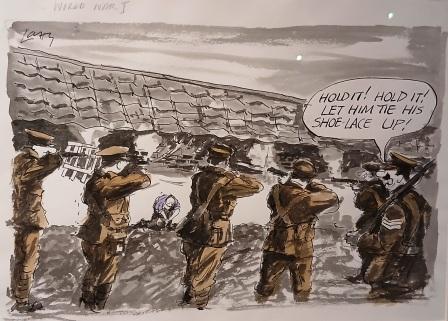 Cartoon from World War I.
Representative was one for World War I in which a squady – presumably have post-traumatic stress disorder or some such is being shot.
There were also more contemporary political comments.
 There were also contemporary political comment cartoons.
The Science Fiction exhibition – How The Future Was Then – was loosely presented as a timeline. Early SFnal representations included the US newspaper comic strips Buck Rogers (from 1929) and Flash Gordon (from 1934).
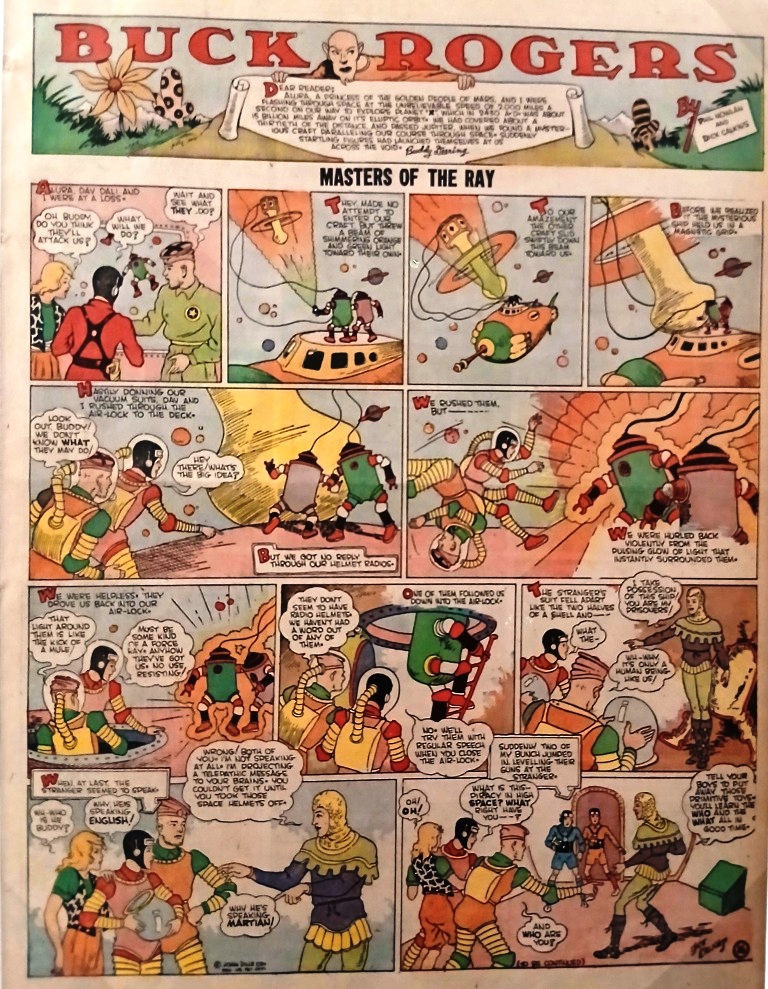 A Buck Rogers strip from 1930.
Buck himself was a former US soldier in World War I who in 1920 subsequently got a job as a mine surveyor where he stumbled into a subterranean gas pocket and went into a gas-induced sleep, shielded from the world by a cave-in, to awake in the fantastical future of 2419 in the midst of another war, this time with China…
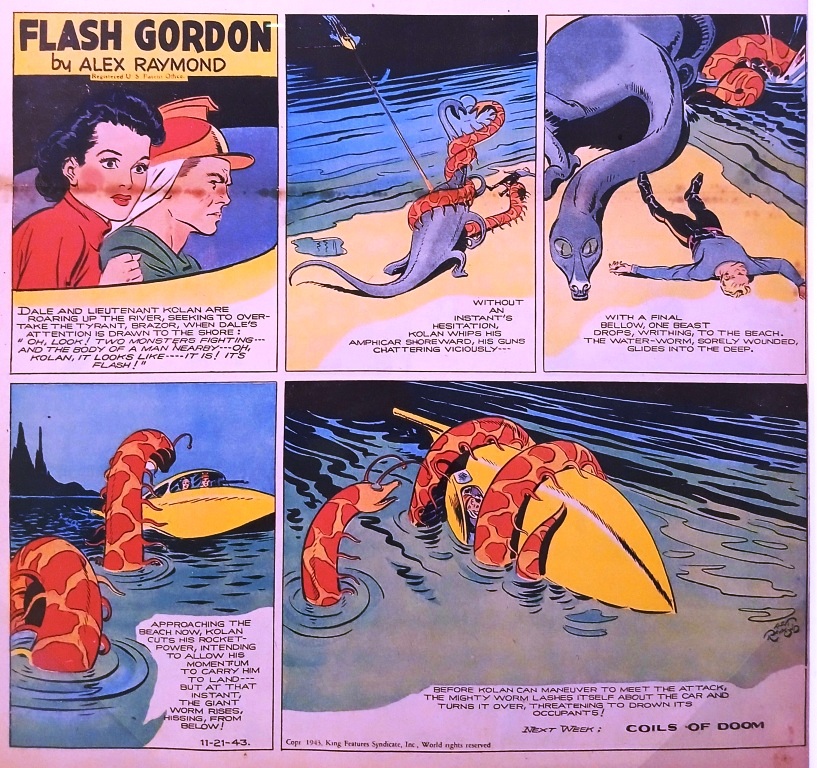 A early Flash Gordon strip.
The Flash Gordon comic strip ran as a Sunday strip from 1934 until 2003 and so surpassed the popularity of Buck Rogers. l; Flash was a handsome polo player and Yale graduate, He encounters the unhinged inventor Dr. Hans Zarkov whose rocket ship he proposes to use to investigate an approaching planet (mongo) that threatens to collide with the Earth. Flash has many adventures on Mongo.
Both Buck Rogers and Flash Gordon also appeared in film serials, television and more recent, late 20th century, feature films.
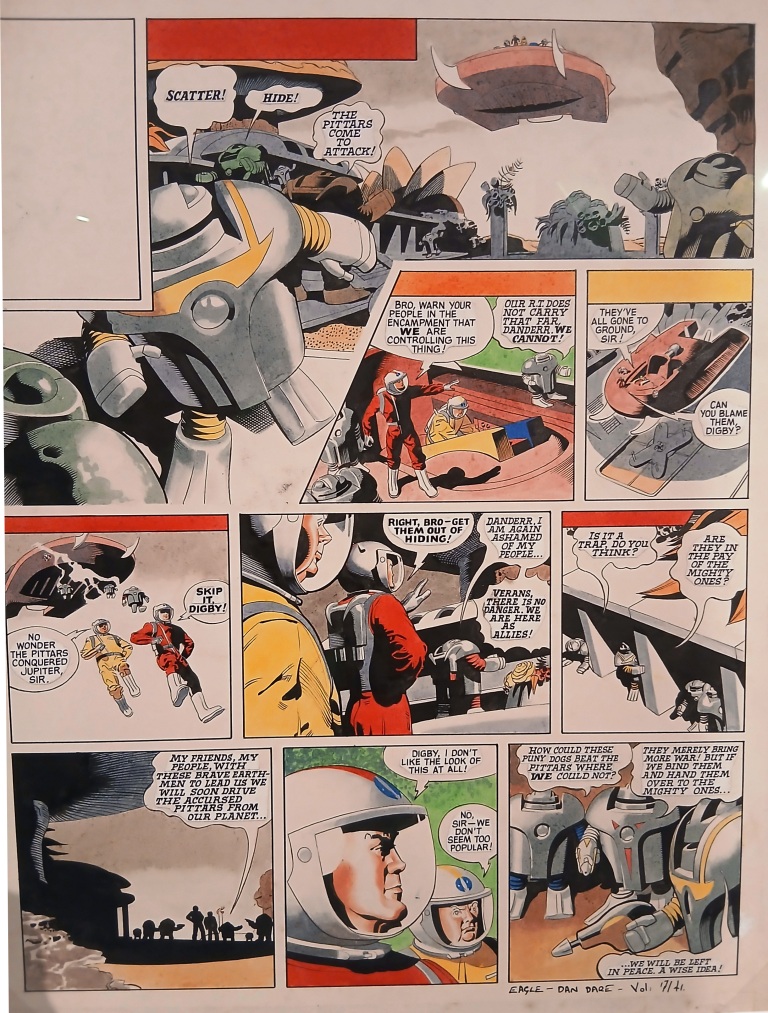 Britain had its own comic strip astronaut in Dan Dare
Post World War II, Britain had its own comic strip astronaut in Dan Dare that appeared in the Eagle comic (1950–'67). He was portrayed very much in the tradition of a World War II Royal Air Force pilot who just happened to fly interplanetary space ships about the Solar system battling his arch enemy, the Venusian Mekon. Decades following Eagle, Dan Dare returned in new strips in the a Href="https://en.wikipedia.org/wiki/2000_AD_(comics)" target=_blank>2000 AD comic in 1977 until 1979 and in the re-launched Eagle in 1982 until 1994. The original Eagle Dare stories were written and drawn before the early space probes of the 1960s and it was thought that there was life on Mars and Venus as well in the day/night band on the then-assumed tidally locked Mercury. There have been comic collections of the strips.
The Eagle comic also carried educational articles on technology and these included portrayals of future technology. For example, the 1965 Eagle Annual had a piece on home computers. (Comic annuals are a British tradition whereby a comic produced a yearly book featuring standalone stories of some of the strips and other material.) 1965 Eagle Annual article predicted that every home would in the future have its own computer that would take up a large part of the home's living room and would come with tele-printer, large tape spools, keyboard, dial-up modem and a large TV screen. The article did though correctly predict that there would be miniaturisation and, in all but name, fibre optic cabling.
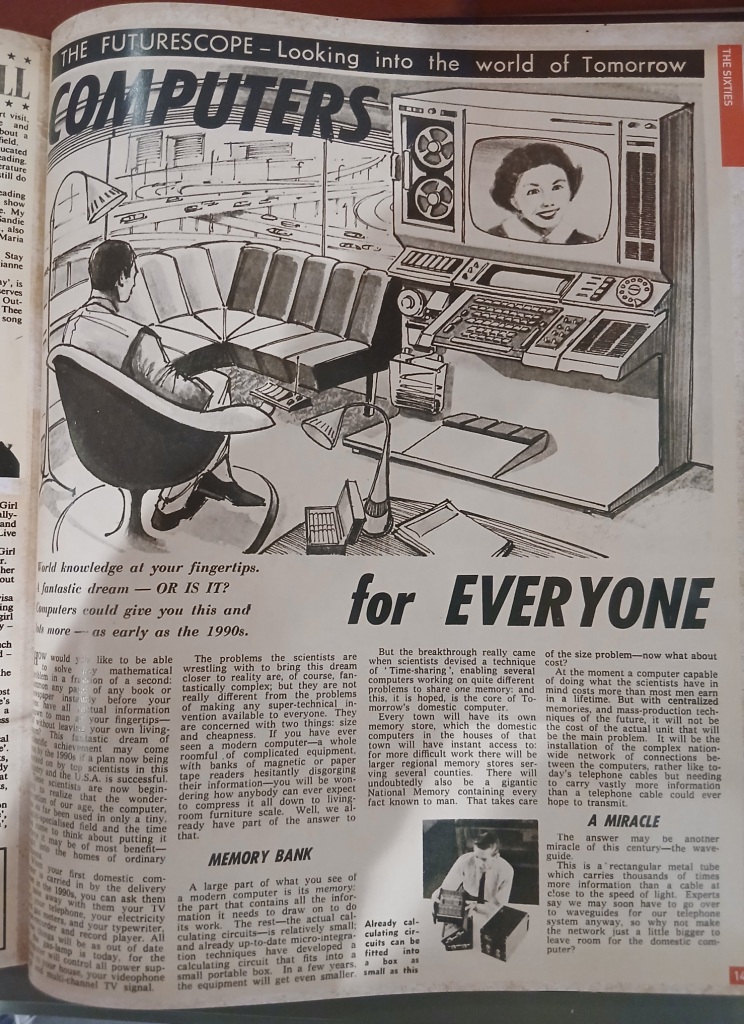 Home computers in every home…. Eagle Annual 1965.
There was a kind of version of Dan Dare, and over lapping with him, in the form of a daily newspaper strip, Jeff Hawke (1954-1975). Jeff Hawke did not have the large colour artwork spreads of Dan Dare, being black and white and restricted to a small (typically three frames) week-day strip. However the Jeff Hawke stories were arguably a lot more SFnal than Dan Dare. Hawke's creator, Sydney Jordan, was a graduate of am aeronautical technical school. He, and Hawke's co-creator Eric Souster, had both served in the RAF. Hawke appeared in Italy, Sweden, Spain, ex-Yugoslavia and some other European countries. In the United States, Jeff Hawke was printed in the Deseret News and was reprinted in Menomonee Falls Gazette. There have been comic collections of the strips.
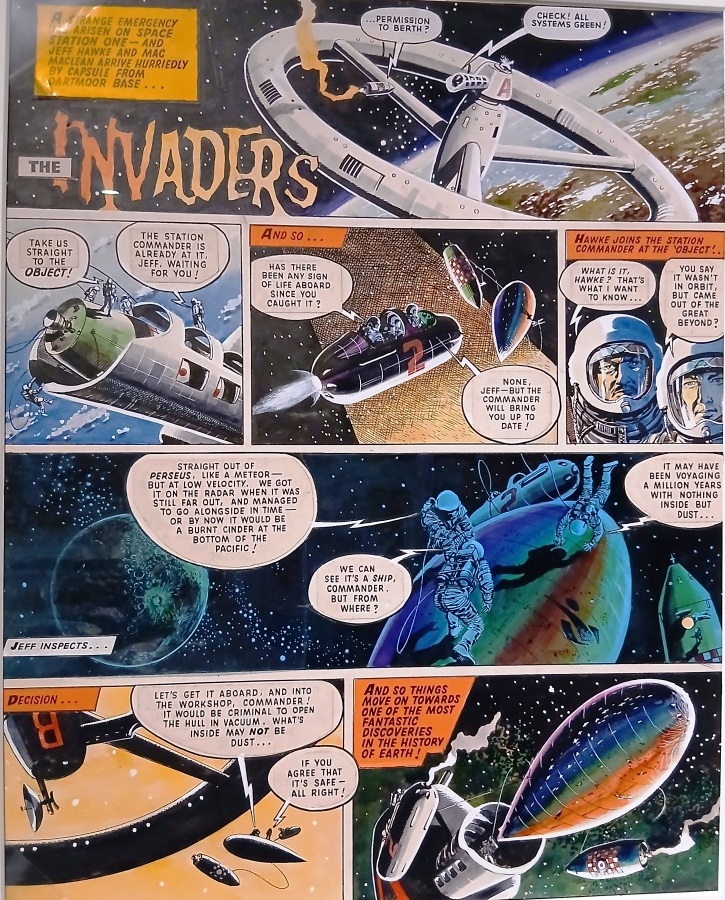 A page from a coloured Jeff Hawke and never-used Hawke strip drawn in 1960.
This particular strip was for a proposed new comic that never came to pass.
It is difficult to talk about British popular SF without a mention of Doctor Who and his arch foes the Daleks. The daleks had their own strip in TV Century 21 with the blessing of the Daleks creators but not featuring Doctor Who as the comic strip rights for that had gone to another publisher.
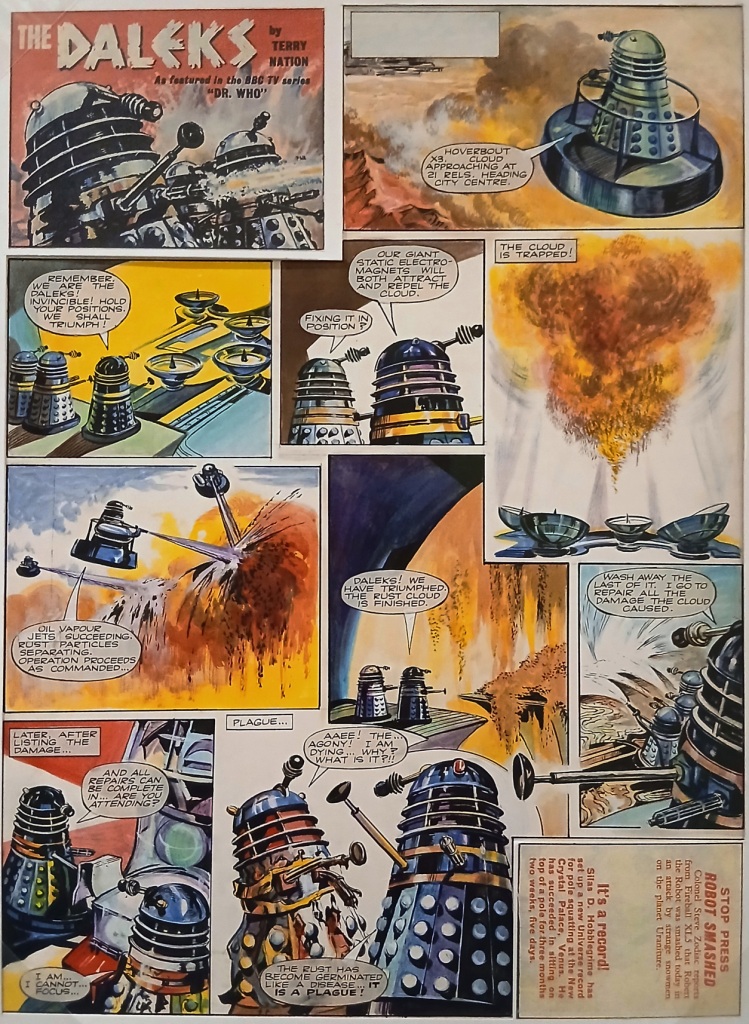 The Daleks strip in TV Century 21
But the Daleks really were something of a minor addition to the comic. The TV Century 21 itself was a comic landmark in the great (unintentional) Gerry Anderson experiment of a series of SFnal television shows through the 1960s. Arguably these began with The Adventures of Twizzle (1957–'58), Torchy the Battery Boy (1960), and Four Feather Falls (1960) These were aimed at four-to-five year olds. Then came Supercar (1961–'62) and Fireball XL5 (1962–'63) for slightly older children. This was followed by Stingray (1964), the hugely successful Thunderbirds (1965–'66) and Captain Scarlet and the Mysterons (1967). There were a few other puppet series but the live-action mixed with models UFO (1970–'73) and Space 1999 (1976–''77) were for a more adult audience. Effectively what had happened was that a whole generation of children grew up with a succession of Anderson SF shows. The TV Century 21, and its various rebrands incarnations (1965–'71) brought together strips based on a number of these shows and attempted to provide a coherent, shared 21st century future. Not surprisingly, with Anderson's shows capturing a generation of kids, the first edition of the comic sold well: one million copies!
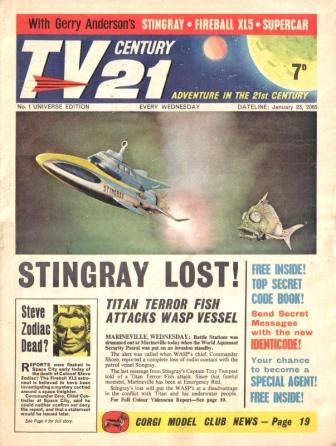 Cover of the one-million selling TV Century 21 issue no. 1.
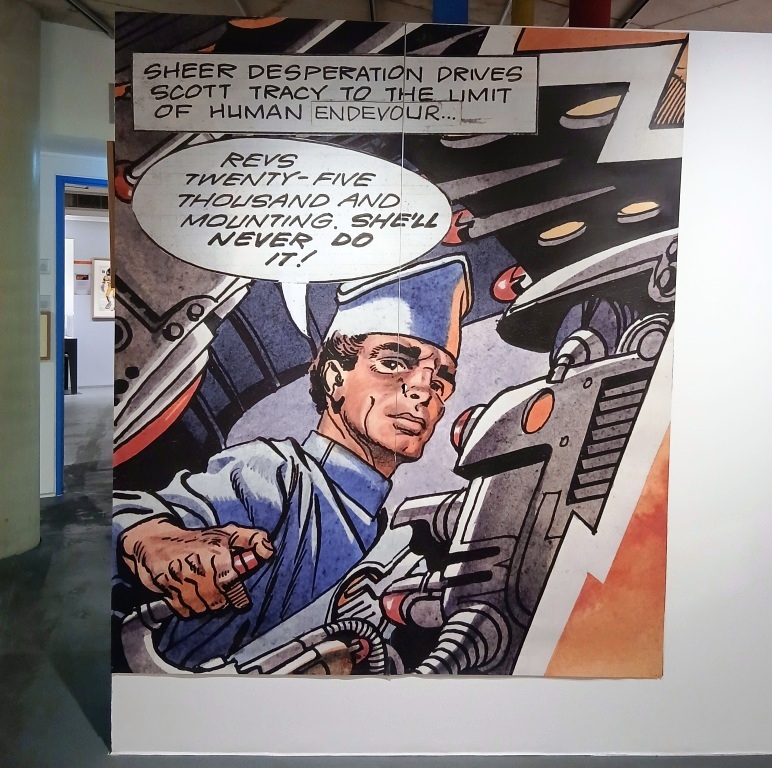 Part of the Thunderbirds display.
At this point it is worth noting that one of TV Century 21 sister comics, Joe 90, carried a number on non-Anderson related strips taken from TV shows and notably Star Trek. Star Trek premiered in the USA in September 1966 but did not air in Great Britain until July 1969. The Joe 90 comic editors were only sent an episode outline and some stills from the show and they had not seen the show for themselves. Consequently, the early Star Trek strips in Joe 90 had a number of quirky oddities that were not in the television show. (See Star Trek: The Classic UK Comics.)
The history of SF comics and future portrayals in that medium also saw comic adaptations of literary works even if often via cinematic versions. One such was Philip K. Dick's Do Androids Dream of Electric Sheep (1968) filmed as Blade Runner (1982).
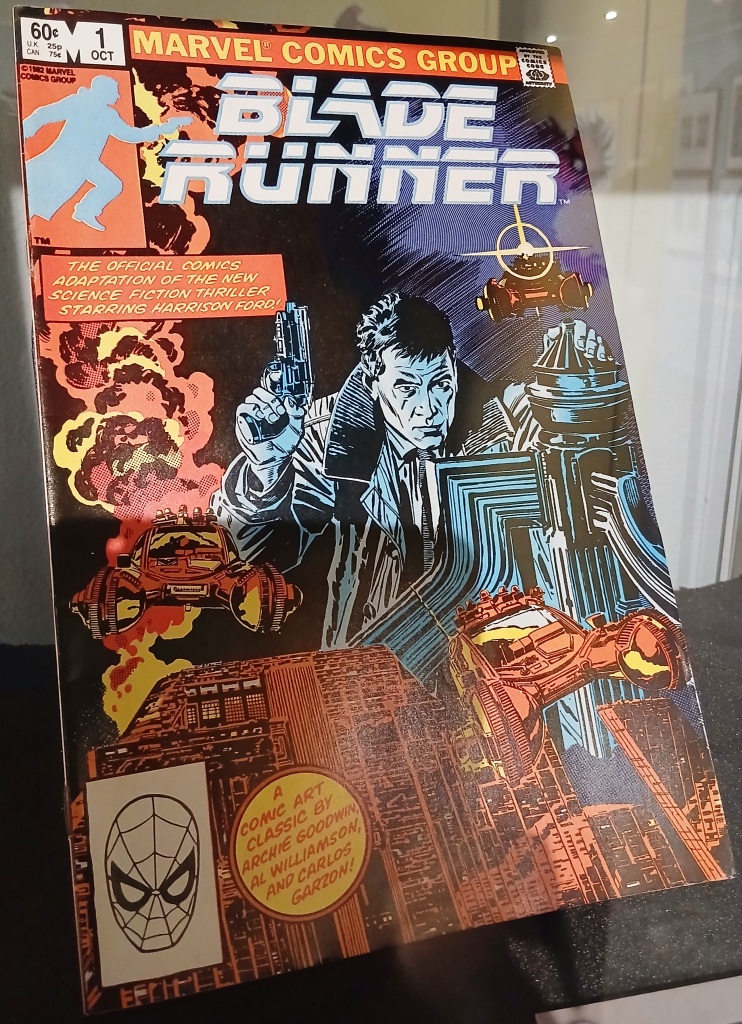 Do Androids Dream of Electric Sheep (1968) filmed as Blade Runner (1982)
With a comic adaptation.
There was a lot to the Cartoon Museum's ' How comics saw the future' exhibition and too much to cover it all here. Along the way we got a number of exemplars including the Romano-sand-and-sandals-technopunk The Trigan Empire.
More recent comic landmarks and portrayals of the future were presented with the various worlds of 2000AD and especially Judge Dredd. Though here Dredd in particular speaks to the present as much as any future as explored in Michael Molcher's excellent, Hugo-long-listed I Am The Law
How Judge Dredd predicted our future: an absolute must for Dredd followers concerned with human liberties and politics.
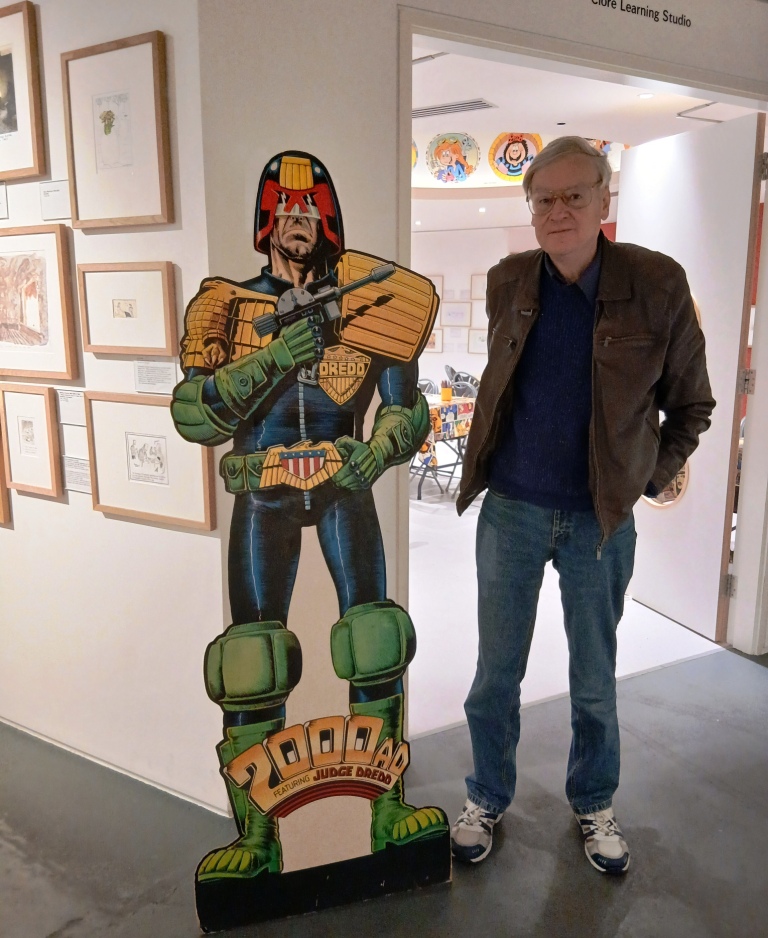 Judge Dredd with perp.
Science Fiction to some is a frivolous and superficial genre: a view fairly prevalent some decades ago but, fortunately, less so today. The Cartoon Museums exhibition literally illustrates that the genre is one of imagination and can be a vehicle for social comment among much else. As such it was most welcome.
|