Does life on Mars doom humanity?If life arose on Mars independently of Earth then the
Physicist Matt O'Dowd, over at the PBS Space-Time YouTube channel, has taken a look at the recent discovery of signs of possible ancient life on Mars and its implications.(1) The discovery itself was announced in a paper in Nature mid-September (2025).(2) Cue brief recap. The Perseverance rover has discovered these strange mineral splodges (forgive the technical term) on the bed of a billions years-old former river that entered Jezero Crater which itself, billions of years ago, was a lake. Here's the thing, these carbon deposit mudstones areas were surrounded by bands enriched in ferrous iron phosphate and sulphide minerals. Now, the carbon alone is quite interesting (we have found many carbon samples elsewhere on Mars) but it is not firmly indicative of past life until we can get a sample back to Earth and do an isotope analysis (life-born carbon is likely to be enriched in carbon-12 and depleted in carbon-13). However, the ferrous iron phosphate and sulphide minerals are interesting as it suggests that there was iron and sulphur reduction, simultaneous with organic matter oxidation and that is exactly what you would expect with some microbial metabolic action. Indeed, it is difficult to say how these minerals, in that environment, could have formed without life! Yet, 'difficult' is not 'impossible', so we really do need to give these samples a far more detailed analysis, but a certain Mr Trump has slashed US science (which had formerly been 'great' and world-leading but now leaves the world's top science-active nations as being European and China among a few others). One casualty of this assault on science is the (formerly) planned NASA Mars sample-return mission. 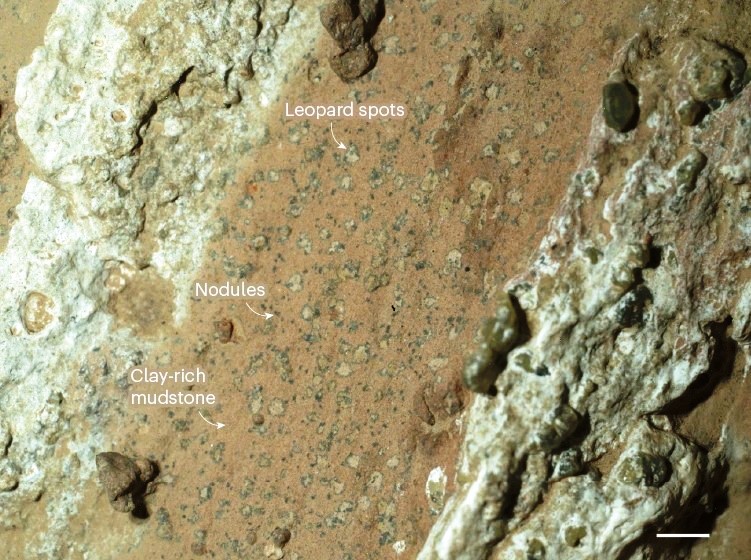 The mysterious Mars minerals found by the Perseverance rover.
OK, so that's the recent discovery and where we are. What of the implications? Matt O'Dowd reviews the discovery in the first four minutes of PBS Space-Time's October (2025) 20-minute video (see the end of this article). He then goes on to speculate, that if this is a detection of former life, what are the implications for life in the Galaxy at large? Here Matt enters some decidedly SFnal territory. We do know that there is life on Earth – you are reading this – even if it is not particularly intelligent life (just look at who all too often we let lead us). Now, it could be that life on Earth is unique in the Solar system, if that were so then the implications for life – including intelligent life – elsewhere in the Galaxy would be potentially profound. First, we have to discount a confounding hypothesis: that life on Earth and Mars has the same origins taking a ride on asteroid ejecta from one planet to the other. We need to park that notion to one side before we continue our contemplation. 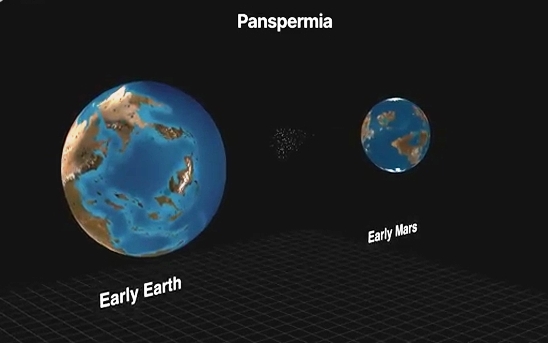 Could life have transferred between Mars and Earth?
If Perseverance's discovery really is of ancient life on Mars and this arose independently of life on Earth, then the implications would be that that life – at least microbial life – is really common in the Galaxy. And if microbial life is common then that ups the chance of the rise of technology wielding life elsewhere in the Galaxy! But – and isn't there always a 'but' – we have yet to detect biosignatures let alone technological signatures of life elsewhere in the Galaxy! (There would be more rolls of the dice.) What this suggests, is that there is some sort of a 'filter, a 'Fermi filter' to be precise, that impedes the rise of technology-wielding, interstellar-going, species from common, simple life. If there was such barrier then it would be a Great Filter that sieves out the rise of technology-wielding, interstellar-going species across the Galaxy.(3) The next question arises is what is this Great Filter? Well, we don't know, but we do know that we humans exist and wield technology. So, it could be that we have yet to encounter this filter and that it is a 'late filter' (one in our future) that prevents interstellar colonisation. Here the reason that we have not yet encountered this filter is because it is in our future! An alternative hypothesis is that this filter is an 'early filter' that it is in our past. It could be that the 'rise of life' is one such early filter and that we just happened to be very lucky that life rose early on Earth (3.7 – 4.0 billion years ago) so giving the time for oxygen-generating photosynthesis (possibly around three billion years ago) and multicellularity (about one-and-a-half billion years) to evolve and then for us to arise after the Cambrian boom (or Cambrian explosion), and a few partial planetary re-sets (such as the dinosaur extinction – I have never really forgiven the dinosaurs for what they did to Raquel Welch). 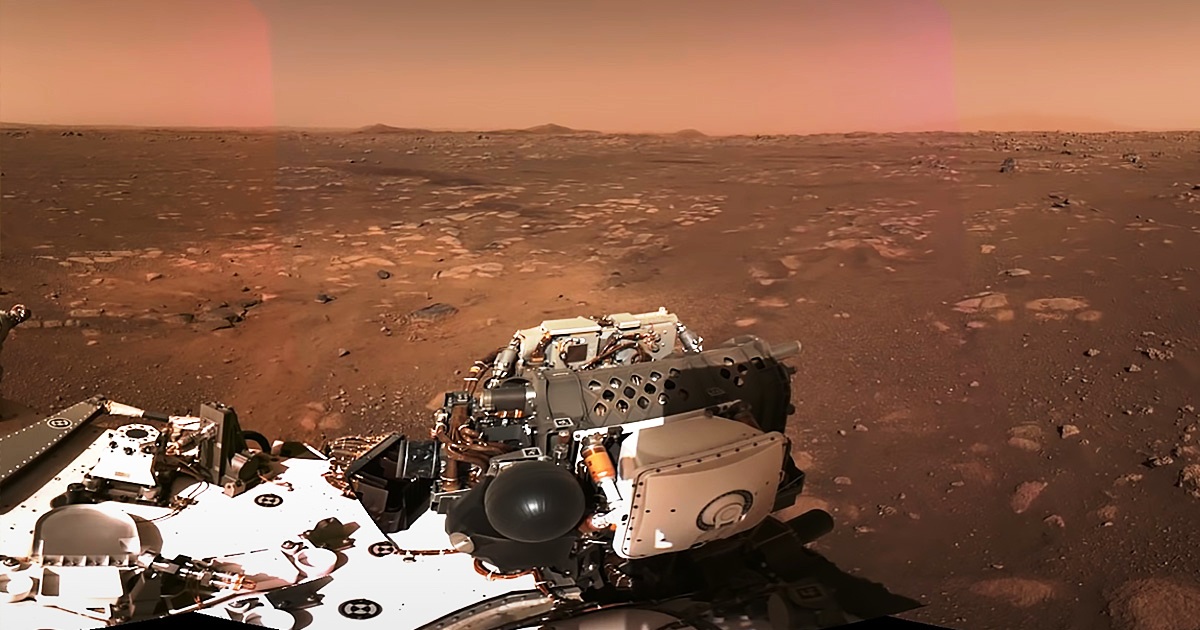 Perseverance at its landing Martian site
This is where Perseverance's discovery of the signs of possible past Martian microbial life comes in. If life did arise independently on both Mars and Earth then one major, early Fermi filter can be ruled out. It would appear that the rise of life itself is apparently an easy evolutionary step. If this is the case, Matt O'Dowd muses, and if things like the rise of eukaryotes ('good' cells) from prokaryotes (simple, 'before nucleus' cells), multicellularity, are easy evolutionary steps, then this means that the great filter is not an early filter but a late one. The more we rule out great filters in the past; the more likely that a great filter is in the future! It means that we have yet to encounter it. Such a late filter could be global Armageddon through nuclear war, or it could be that interstellar colonisation is so difficult as being next to impossible. Or it could be that super-artificial intelligence destroys us: Skynet is an obvious SFnal example. (I have often warned that the machines are taking over, but no-one ever seems to listen.) If all this is the case, the Perseverance's discovery – should it really be a sign of former early Martian life – could be evidence that we have yet to encounter the great filter: it could be evidence of our doom to come! The filter has to be somewhere: we don't see aliens. 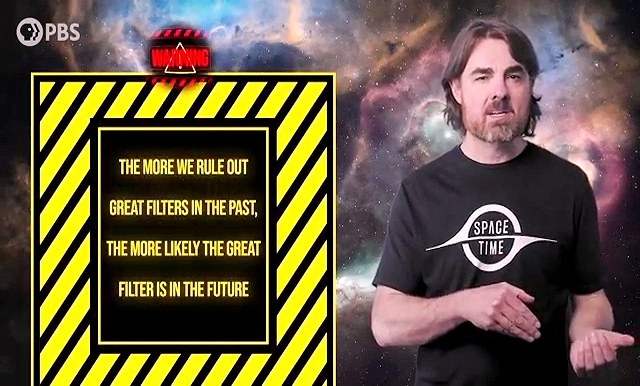 Matt O'Dowd ponders if the great filter is in the future.
This idea of a future great filter is not new; it has been put forward by others. Matt O'Dowd is just reminding us of this in the light of Perseverance's recent discovery that, at the very least, we should not taker for granted our continued survival into the future as putative Martian life is now stronger evidence of existential risk. (Remember from earlier, it could still be that our life on Earth is Martian and that the rise of life itself is a difficult step. We need to bear in mind this caveat.) OK, so where does that leave us? Well, while I will leave the detail of my own feelings on this topic for elsewhere, I will make just a couple of comments now. First, it could very well be that life could arise more easily on an early Mars than an early Earth. The ratio of land to sea on early Mars was much higher than on Earth (this has nutrient release implications) and there were numerous crater lakes on Mars each of which could provide nurseries for life once it got going. Alas, Mars' magnetic field ceased early on and its atmosphere began to be eroded by Solar wind. Meanwhile, the Earth had conditions capable of supporting a long-lived biosphere, so once life on Earth got going here it could, given time, flourish. The second thing, is that the process that gave rise to eukaryotes (endosymbiosis, symbiogenesis and specifically in the case of eukaryotes, eukaryogenesis) and subsequently the rise of multicellularity both occurred independently a number of times on Earth (even if eukaryotes only evolved once). Anoxygenic photosynthesis (non-oxygen-generating photosynthesis) also arose a number of times and this suggests that these too were comparatively 'easy' evolutionary steps. Only oxygenic photosynthesis (oxygen generating photosynthesis as used by plants) initially arose once (in cyanobacteria) and this was then subsequently modified numerous times, including being purloined by the aforesaid plants. So it looks like many of the main candidates for early Fermi filters are actually unlikely filters. A final thought relates to this oxygen-generating photosynthesis and the possibility of it arising on Mars. Back in 2019 it was reported that over a five Earth-year (three Mars years) period the Curiosity rover had detected seasonal oxygen in Mars' Gale Crater.(4) We do not know of any non-biological reasons for this seasonal oxygen (though there may be an unknown geological reason, but if so no-one has yet thought of it). Could it be that oxygenic photosynthesis arose early on Mars? If this were so then it could have risen early on Earth too, but the reason it took so long to transform the Earth's atmosphere is that the biosphere (geology, oceans as well as atmosphere) was so vast and so different (chemically reducing as opposed to chemically oxidising) that it took literally billions of years to transform to its present state. If this is so then complex life my not be as rare in the Galaxy as some pessimists think, even if technologically-wielding life is rare, or interstellar colonisation too difficult or impossible. Either way, it would be prudent to be aware of possible future Fermi filters. You can see Matt's 20-minute video below.
Jonathan Cowie References 1) O'Dowd, M. (2025) Why Life on Mars Will DOOM Humanity? PBS Space-Time, 2nd October 2025. 2) Hurowitz, J. A., et al. (2025) Redox-driven mineral and organic associations in Jezero Crater, Mars. Nature, vol. 645, p322-340. 3) Hanson, R. (1998) The Great Filter - Are We Almost Past It? George Mason University paper: Virginia, USA.. 4) Trainer, M. G., et al. (2019) Seasonal Variations in Atmospheric Composition as Measured in Gale Crater, Mars. Journal of Geophysical Research: Planets. vol. 124, p3,000–3,024.
[Up: Article Index | Home Page: Science Fact & Fiction Concatenation | Recent Site Additions] [Convention Reviews Index | Top Science Fiction Films | Science Fiction Books] |