To Mask or Not to Mask
That is the Muffled Question
Peter Tyers ponders on masking policies at SF conventions
It used to be that the only time I saw people wearing masks, other than the bad guys in cowboy films and TV shows, was in operating theatres, the dental surgery, industrial areas, and the like, where the need for hygiene and cleanliness was absolute. These places were, in my personal experience, rare. Then, early in 2020, this changed. The world was gripped by the CoVID-19 pandemic and masks were, very sensibly, mandated almost everywhere.
After a while, with the advent of widespread vaccination against the disease and immunity growing, and the numbers of infected people decreasing rapidly, around the world the pandemic was declared to be over. After a while, almost all the special measures that had been introduced were rescinded, national and international travel returned to normal, people stayed in hotels again, attended large events, and life returned pretty much to what it had been. Admittedly, many organisations took advantage of the work-at-home philosophy to reduce the number of staff working in offices, often for their own convenience but also due to a growing demand from workers who realised that they enjoyed not having to commute (amongst other perceived benefits).
Now, these days six years on, I hardly ever see anyone wearing a mask. True, I have a friend with a compromised immune system who has to think carefully before attending events and sometimes wears a mask for their own protection, and occasionally I see a masked person at the local supermarket, clearly (from the coughing) trying to keep an infection to themselves. Unsurprisingly there were masks when I recently attended for some dental work. But that is about it – apart from science fiction conventions!
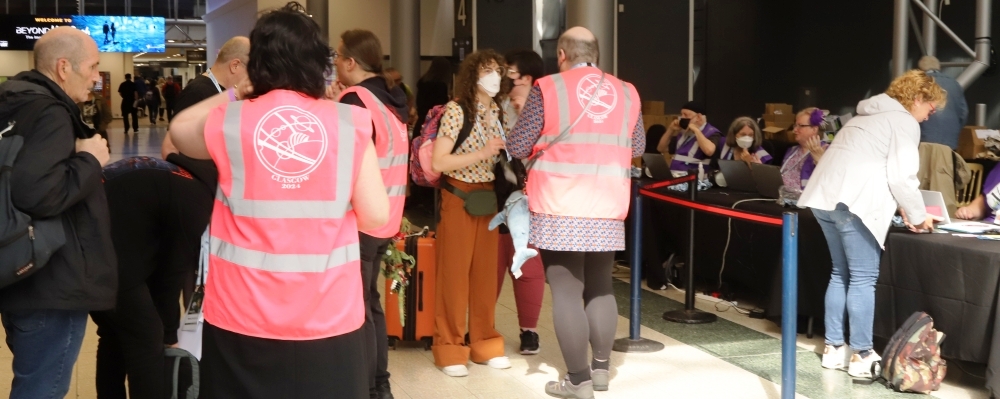 There were just a few wearing masks at Glasgow 2024.
The science fiction community, especially it seems the US American part of the community, is still very particular about them, whilst almost everyone else has forgotten them.
Shortly before the SMOF Con in December 2024, somebody sent round an e-mail alerting those that were previously unaware that the convention had decided to introduce a masks policy (and a fairly strict one at that), a disclosure that surprised a number of people and started interesting discussions.
It seemed that firstly the policy had only been added to the website very recently, and not in a place where anyone would think to look, and secondly that there had been no actual announcement. The first discussion was on the reasonableness of making such decisions without any announcement, meaning that an attendee could arrive at the event and find themselves breaking the rules (which had not existed until very recently) without realising it and without, by then, the option of staying at home.
The second discussion was on when such announcements should be made, with some saying that such decisions should be made and announced by convention organisers right at the very beginning - and stuck to. It should be a published policy from Day One, not merely a much later, if not last minute, decision. No-one should be in the position of joining a convention, booking and paying for transport and hotels, etc., only to find at a later date that the convention had now decided to adopt rules that were contrary to their requirements or wishes and which had not been made clearly known at the time of joining/booking. Personally I agree – changing the rules after joining, without an extremely good reason, is appalling. Obviously, different rules would have to be applied if there was a serious change in circumstance, but even then they should be clearly announced and explained.
A third discussion developed as to whether or not masks should be insisted on anyway. At one end of the argument was an opinion on the lines of ‘masks are absolutely essential at all times and with no exceptions other than those moments when actually passing food or drink through the mouth and anyone who fails to understand this should be excommunicated from the entire world’ whilst at the other end of opinion it was on the lines of ‘masks get in the way and nobody should be allowed to wear one for any reason at all’. There were, of course, opinions between these extremes and yes, I have specifically worded them as extremes, and nobody actually said these words.
Those in favour of wearing masks pointed out, quite correctly, that they do reduce infections. Indeed, over the winter of 2024/25, some NHS hospitals were thinking of reintroducing mandatory mask wearing due to the very high number of respiratory infections they were suffering from, though in the end they did not do so. However, some of the pro-mask opinions came across as being of almost missionary zeal.
Some of those arguing against mask wearing did so from the point of communication. The human race evolved to not only hear what people said but to watch their faces as they spoke. As was explained to me once by the head of the hospital audiology department, when we listen to speech we mostly hear the sounds but, nonetheless, we all lip read to some extent and we also watch facial movements; if we are limited to just sound then we all loose some of the information which we evolved to make use of.
In short, it is more difficult to correctly understand people if you are restricted to sound alone (which is why radio announcers and radio actors speak so clearly). This is so especially if you also have to deal with other factors such as background noise, accent, poor diction, a quiet voice, hearing weakness of any kind, and so on. One of the most important aspects of conventions is to meet and communicate with others and quite simply that communication is interfered with by the use of masks. If the listener has problems of any sort with hearing under the circumstance, then the wearing of masks can reduce communication and even simply stop communication happening – and that is not something that a convention should wish to achieve. As some put it, if masks are to be worn then they will not be able to hear adequately and there is therefore no point in them being there. Driving people away is not something that conventions should do – and codes of conduct have so many rules on inclusivity and acceptance of others!
Some might reply that transparent masks are available, but that is of little relevance unless everyone is wearing them. Simply being transparent is not a full solution either as they can be difficult to see through (they often have very shiny surfaces which are subject to catching reflections). These masks obstruct seeing facial movements and can also make voices sound a little strange. No, the only answer to full communication for those with any form of difficulty understanding the speech of another, is to be able to see the entire face – i.e. no masks.
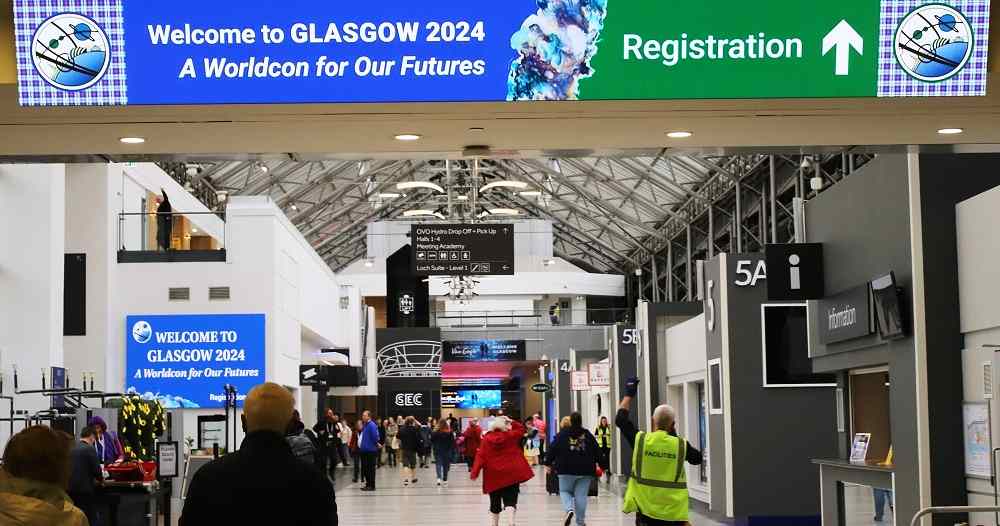 At the Glasgow Worldcon in 2024, the convention followed the government line of not insisting on masks (and it might have caused a few legal problems if they had insisted); the 2024 Worldcon Disease Mitigation Policy made it clear that mask wearing was personal and that everybody must respect the decisions of others. Those that supported mask wearing must not comment on those who chose not to wear masks, and those who did not wear masks must not comment on those who did. Despite this, I read comments from a few of the US Americans who attended that they thought that Glasgow was wrong not to enforce the rules demanding mask wearing – when there were no such rules, let alone the legal requirements that they implied!
Seattle in 2025 also made mask-wearing optional and its rules stated that everyone should respect everyone else’s decisions, whilst themselves leaning very strongly in favour of mask wearing. I noticed that in many reports the writers has particularly stressed their own wearing of masks, which implies a possible lack of respect to others, despite the rules on not commenting.
I spotted one review of the Glasgow Worldcon that reported about 20% of attendees were masked, which was not the case! I saw very few masks, and checking through my photos confirms this. Apart for a couple from Japan, every mask from behind which I heard a voice, that voice had an US American accent.
Looking purely at the last two Worldcons, did they have a serious problem with CoVID-19 infections? Both recorded infections on their Discord channels but nowhere else; I do not use Discord so I do not have access to those figures and I have not been able to find any other official reports on the subject from those conventions. Somebody reported that (according to Discord) there were something over two hundred cases at/after Glasgow (a mixture of picking it up when travelling to/from the con and whilst at the event), which is under 3% of the attendees. Seattle’s final at-con ‘Zine reported (presumably taken from their own Discord channel) a mere eight infections in total (a tiny 0.12% of the attendance). So was CoVID-19 actually a problem of significance at these events?
Once the CoVID-19 restrictions were lifted, in almost all walks of life the wearing of masks soon disappeared and so did the request, let alone the requirement, for testing before attending any sort of event. Both masks and testing were soon forgotten. I have done a fair bit of travelling (some by air, some by long distance coaches) in both England and Western Europe, attended many events (large and small) and several festivals, and CoVID-19 never gets mentioned. Masks are rarely seen, and then usually only on people who are particularly vulnerable in some way (one does not ask!). I have seen more people donning plastic gloves before serving ice cream than I have wearing masks, which gives you a fair idea of just how little mask wearing there is in general.
All this leaves me wondering – is SF fandom the last remaining bastion of common sense or has it become a place where those with evangelical ‘rightness’ can hang out and claim self-seen superiority over others? And, given that all round the world most events of every sort have done away with CoVID-19 rules and mask wearing, including in essence some SF conventions, is it mostly US American fandom that is so affected?
Yes, CoVID-19 can be very nasty, though most vaccinated people comment that it was not as bad as they expected (which is not say that they were not properly ill). But there are many, many other communicable diseases out there and CoVID-19 is just one of them. Should we be more careful about all of them? Maybe we should. Do we generally wear masks to keep the others at bay? No we do not.
I therefore have to ask the question – is it time for fandom to follow the rest of the world and hang up the mask?
Peter Tyers
[Up: Article Index | Home Page: Science Fact & Fiction Concatenation | Recent Site Additions]
[Most recent Seasonal Science Fiction News]
[Convention Reviews Index | Top Science Fiction Films | Science Fiction Books]
[Science Fiction Non-Fiction & Popular Science Books]
[Posted: 26.1.15 | Contact | Copyright | Privacy]
|