Has the Science Fiction Worldcon shot itself in the foot?

Following eight decades of positive development
the past half-decade the Worldcon has seen multiple failures
of adherence to its own constitution.

This breakdown in governance is
undermining credibility in the Worldcon brand.

Jonathan Cowie recounts the history of recent
governance collapse step-by-step and reveals that fans may
now be withdrawing tens of thousands of pounds worth of support!

This is going to be a long article, so buckle up...


The establishment and growth of Worldcon
The Science Fiction Worldcon is just a few year's off celebrating its 90th anniversary. It has come a long way and has become one of the centre points of the annual speculative fiction calendar.  The first event was held in 1939 in New York, to coincide with the World Fayre, with just a couple of hundred in attendance. But back then it was not really a 'World' convention in the international sense. It was not until 1948 that it was held outside of the USA in Canada and it was not to leave the US again until 1957 (Great Britain) and after that not until 1965 (Great Britain again).

Yet, despite much positive development over many decades, the Worldcon seems to have hit a period of extremely poor governance.

The purpose of this piece is not to school or educate those into Worldcon matters, folk who regularly attend the WSFS Worldcon Business Meeting: those fans will (or should) already know all this.  Others, who only occasionally go to Worldcon, when it is held in their neck of the woods, and who never go to the Business Meeting may find this article has things new to them.  But my main purpose in writing now is to put everything in one place so as to exorcise this from my mind and to counter those that might accuse me of staying quiet.  After all, John Stuart Mill (1867) said that all bad men need to get away with their deeds is for good men to look on and do nothing.

Worldcon attendance numbers, a sign of its successful evolution, were to increase but would not to hit a thousand until 1967.  Since then, with the exceptions of 1970 (W. Germany and the first mainland European Worldcon) and 1975 (the first Australasian Worldcon), attendance numbers would remain above a thousand. Subsequently, with the exceptions of 2010 (Australia) membership numbers were to consistently top 3,000. This included the 2020 Worldcon that was run by the New Zealand SF community in the CoVID lockdown year.  Indeed, even in 2021 (Washington, USA), when the world was still very much reeling from CoVID despite vaccine rollouts the total membership topped 3,000.

In the 2000s, total membership numbers for Worldcon (both 'Attending' and 'Supporting') have topped 5,000 with just the exceptions of 2003 (Canada), 2008 (Colorado, USA). Even East Asia's first Worldcon in 2007 (Japan) saw over five thousand members.

Over the years the Worldcon has also become increasingly international.  The 'World' in Worldcon originally related to the 1939 World Fayre in New York and not that the convention was a celebration of international SF.  Indeed it was not until 1957 that the Worldcon was held outside of N. America and during this period it was only once (1948) was it held outside of the US when it took place in Toronto, Canada: that one non-N. American Worldcon, in 1957, was held in Britain.

The 1960s was a similar story: all but one of the Worldcons was held in the US and that one non-N. American Worldcon was the 1965 convention in Britain.

The 1970s saw the first significant move to a truly international convention. Four of that decade's Worldcons (W. Germany, 1970; Canada, 1973; Australia,1975; Britain, 1979,) were held outside of the US. Indeed, the 1979 Worldcon in Brighton was my own first Worldcon: I was subsequently to register for a total of eight, of which I attended seven.

Alas the success of the 1970s growth in internationality floundered in the 1980s with just two (Australia, 1985; Britain, 1987) being held outside of the US. But the 1990s, 2000s and 2010s were better with once more four being outside of the USA (Netherlands, 1990; Canada, 1994; Britain 1995; Australia, 1999; Canada, 2003; Britain, 2005; Japan, 2007; Canada, 2009; Australia, 2010; Britain, 2014; Finland, 2017; Ireland, 2019).

The first half of the 2020s seems to be continuing this trend of four out of ten Worldcons being held outside of the US. The Worldcon has come a long way from its first decade through to the 1950s when all were held in N. America and just one outside of the USA. It has, today, become more international even if the US still is a disproportionally dominant venue nation.

The Worldcon programme also continued to develop.  The first Worldcons had a core single programme stream with some bolstering, adjunct facilities such as a dealers' hall (hucksters room as it is often called in the US) and art show.  But by the time of my first Worldcon in Brighton, Britain (1979), there were a number of programme streams including a film programme. The main programme saw talks and interviews dominate supported by quiz and game items as well as some panels.  However, things were to change.  The 21st century saw the decline of the film programme though there were notable exceptions such as 2010 (Australia) which had three parallel film programme streams including one of international films with some non-Anglophone SF.  Such Worldcon film programmes a rare opportunity to see offerings not commonly released in English-speaking nations even today with streaming platforms.  Today, for better or worse, one does not go to the Worldcon to see films: Glasgow (2024) became the first British Worldcon not to screen any films.  Panels dominate recent Worldcon programme streams with major author interviews relegated to over-subscribed coffee table meets for just a dozen or so.

The Glasgow 2024 Worldcon programme
(Data from the Glasgow Worldcon website)
13 book launches
30 autograph sessions
12 concerts
401 panels
11 talks
7 interviews
56 readings
51 workshops
(and, it should be added, 0 films)

This move to panels most likely because they (especially those with fans on them) are easy to organise with no shortage of fans or aspiring writers to willingly volunteer to be on them.  Conversely, arranging an author interview and especially find an appropriate interviewer, is harder, as is curating a film programme that requires specialist knowledge and skill.  This relegation of films at Worldcon is not through lack of demand.  Many nations now have regular genre film fests such as the Festival of Fantastic Films that are independently held in a number of countries.  Here in Britain, for the past quarter of a century we have had the Sci-Fi London film fest.  So the Worldcon has become a very different experience compared to what it used to be.  SF fans have the opportunity of fully attending, 'supporting' or, these days, attending 'virtually' online.  By way of demonstration, this is reflected in the type of Worldcon membership.

Before continuing with a look at membership categories, it is worth pointing out the value of the programme with regards to the failure of good governance.  If the programme is in decline then fans are getting less value.  If, as shall be shown, there is a failure of governance that also entailsless Worldcon value for fans, then fans are likely to withdraw their support.  This, as a again will be shown, is already beginning to happen!


If there is a failure of governance that also
entails less Worldcon value for fans,
then fans are likely to withdraw their support.


Worldcon membership categories.  Time for a back-to-basics look at the types of Worldcon membership for, as we shall see, this may be being affected by the recent failures of Worldcon governance.

Attending Members are those who are entitled to physically attend the Worldcon, its programme and have access to its ancillary convention site facilities such as dealers hall, art show, fan area and so forth. And, of course, Attending members can nominate works and people for the Hugo Award and if those people and works get enough support then they get to go on the Hugo long-list and short-list, the latter of which these members can also vote.

Supporting Members cannot attend the Worldcon but do have Hugo nominating and voting rights.  This is an important membership constituency as while not everyone can afford to travel to the Worldcon (remember the Worldcon has become increasingly international) but this way they can still be involved.  In recognition that they are giving valuable financial support to a Worldcon (Worldcons are expensive to run) they are entitled to receive all the convention's publications. This right is enshrined in the Worldcon constitution and its business meetings' Matters of Continuing Effect.

Virtual Membership is a recent category that began with the New Zealand Worldcon of 2020 when physical attendance was impossible due to CoVID.  Other than that Worldcon, and China's in 2023 (which was state-sanctioned and 'commercially' sponsored), virtual attendance has continually been several hundred (roughly 10% of the combined Supporting and Attending memberships).

'Virtual members' do not physically attend but have all the rights of 'Supporting members' including voting for the Hugo Awards and having special digital access online.  This category will likely grow as the technology develops, though by how much remains to be seen as it is early days for this type of Worldcon membership, as demonstrated by the experience provided by the 2025 Glasgow Worldcon on-line.


Worldcon governance, under which much of this evolution has taken place through to today, is provided by the World Science Fiction Society whose members are the whole membership of the current Worldcon. Each Worldcon provides a venue for a 'Business meeting'. The meeting itself (in practice until four years ago and now – as we shall see – now only hypothetically) determines what obligations each Worldcon has to fulfil.  These obligations are laid out in the Constitution of the Worldcon.

Finally, the way the business meeting is conducted itself is specified in the Standing Rules for the Governance of the World Science Fiction Society Business Meeting.  They are further detailed, when extra detail and clarification is required, by the Business Meetings' World Science Fiction Society Resolutions and Rulings of Continuing Effect.

That with each convention held the past three years the Worldcon recently has seen multiple failures in good governance is lamentable. It is this that not only is damaging Worldcon's credibility but, as I shall show, there are signs of it now impacting on it financially as some fans reduce their support for the event!


The Worldcon recently has seen
multiple failures in good governance


These all relate to both implicit as well as explicit failure for the past three (and it seems the currently seated) Worldcons to adhere to the Constitution and its Resolutions and Rulings of Continuing Effect.  I will not detail all of these (that would make this article more tedious than it already is) but confine myself to those that are arguably the most serious.


The 2023 Chengdu Worldcon
The first signs that all was not well with came with the site-selection process for the 81st Worldcon held in Chengdu, China in 2023.  That there were issues was first signalled two years earlier (Worldcon site-selection votes for the Worldcon are held to decide the venue two years hence) by the Worldcon site-selection administrator who that year asked the 2021 Business Meeting whether postal addresses of voters were needed to be eligible as per the constitution (Constitution paragraph 4.4.1.)?  This ruling was given and was advisory and non-binding. For whatever reason the administrator that year chose not to take the meeting's advice and so allowed normally ineligible votes to be counted.  Whatever, this enabled the Chengdu, China, to win. (Site selection overview here.)  However, this was not the major, implicit constitutional concern with the site selection that year.

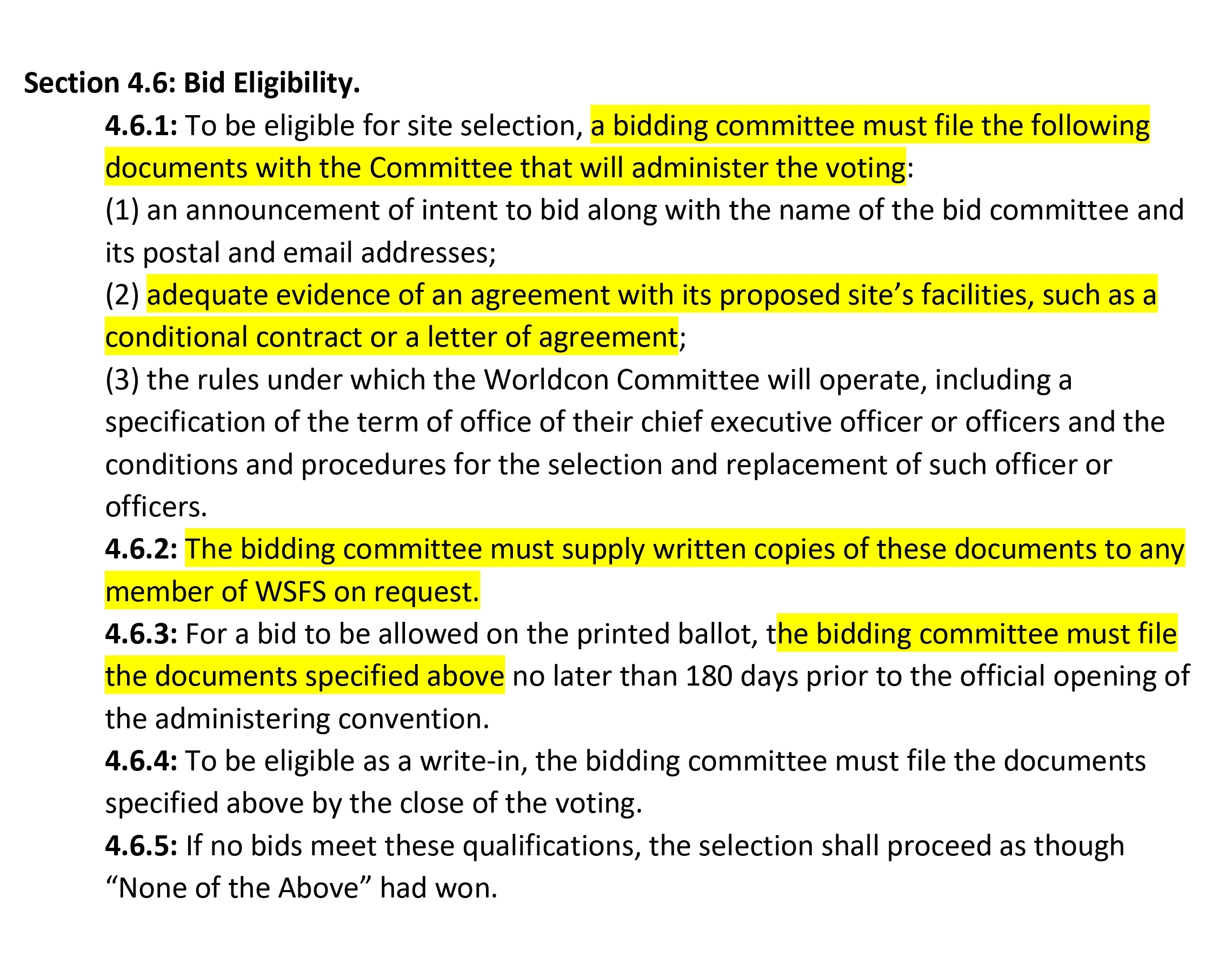
When a group decided to bid for a Worldcon, under section 4.6 of the WSFS Constitution, they have explicitly to provide WSFS with a letter of contract with the proposed bid's venue to assure site selection voters that facilities will be available. Implicit with this is that putative voters know, not only the proposed venue will be available but, the dates of the proposed bid. The Constitution explicitly states that these documents must be available to all those voting. See the highlighted parts of Section 4.6 below.


The Constitution stipulates that those proposing a Worldcon must provide
details of their proposed event in advance of fans voting on bids.
By changing these details after the vote, the event's organisers
are implicitly breaking the constitution.


As noted, in 2021 the Chengdu bid won the right to hold the 2023 Worldcon but not without concern from a number of quarters that this bid was actually a cultural soft-power play and that there were concerns in holding a Worldcon in a country with such a poor level of human rights compliance and illicit territorial sovereignty claims. (So, what's a bit of WSFS Constitution breaking on the side?)  For an example of some of the disquiet, some 80 SF professionals signed a letter calling for the bid result to be revoked.  There was also concern in the convention's Russian Guest of Honour (GoH) heading a petition of Russian SF professions in support of Putin and his invasion of Ukraine.  Indeed, such disquiet was not just expressed by SF professionals in the broader genre community but also by Worldcon fans with the passing of a motion by WSFS members calling for the Russian GoH to be dis-invited.  SF fan communities within countries were also concerned and some expressed this formally such as fans in Poland.  Irrespective, the Russian GoH subsequently went on to re-affirm support of Putin and his invasion of Ukraine.

Meanwhile, remember the Worldcon Constitution's explicit requirement for Worldcon bidders supply documentation affirming facility availability, hence implicitly dates for the event?  Well, in the summer of 2022 the Chengdu convention changed the dates of its event!  So, with a little over year to go, tough luck on those fans who were planning on attending but whose employers insist on substantive leave from work being booked a year in advance meaning that they had already booked time off…  All this, made the failure of Chengdu to release its first Progress Report until the year of the event itself the least of that convention's problems.

But, hey, if breaking the Constitution once was so easy, why not do it twice?  So, in the Spring of 2023, with the event just a little over half a year away, the Chengdu convention changed it dates again and, then for good measure, also changed the venue to a building whose construction had yet to be completed!


But, hey, if breaking the Constitution once
was so easy, why not do it twice?


Anyway, not to worry, the spring of 2023 also saw the Chengdu Worldcon start the Hugo nomination process.  Nothing could go wrong with that, could it?

Meanwhile, some were making calls for WSFS reform, including SF² Concatenation. But the silence from those on the various WSFS Committees, and those attending the Worldcon Business Meeting, was stunningly deafening…  And as for Chengdu's Russian GoH, well he was appointed to Russia's Civic Chamber (sort of analogous to the House of Lords in Britain and the Senate in the US).

The Chengdu Worldcon itself was held with much 'commercial' sponsorship a razzmatazz.  The Hugo results were also announced with the accompanying voting data that showed a drop in numbers participating…  But there was a bit of a bombshell still to come…

As said, up to now a few, individuals and groups, had voiced concerns as to various Worldcon governance-related matters, including ourselves at SF² Concatenation, yet what was to come was at least just as bad.  Some of those administering the Hugo Awards that year chose to depart from the way the Hugo votes are meant to be awarded.

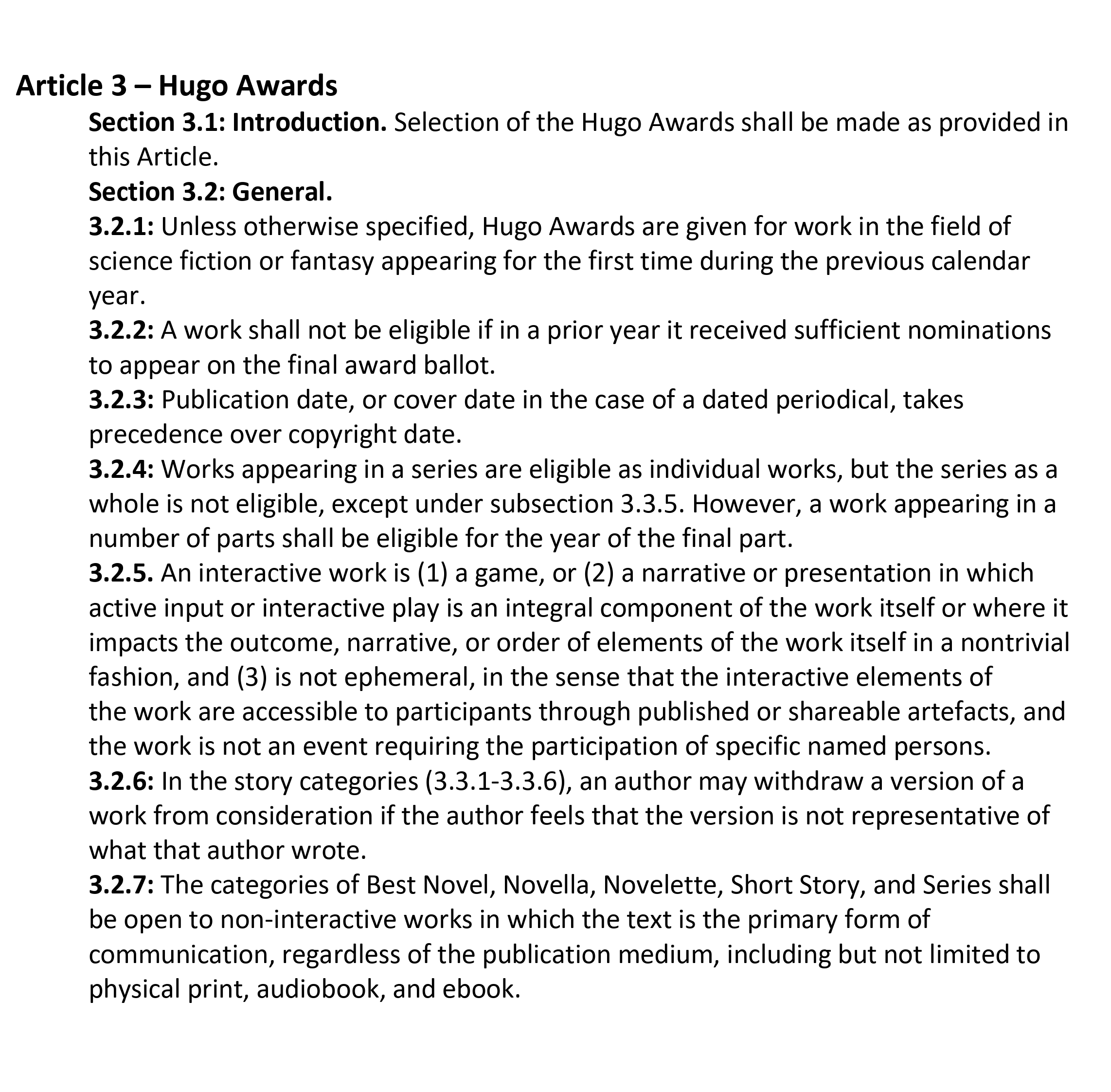
The WSFS Constitution goes into some detail as to how the nomination process is run and also the subsequent vote on the short-list (finalist selection process).  This is conducted under the Constitutions substantive Article 3 (only part of which is depicted below).


Part of the Constitution (above) detailing how the Hugo Awards should be administered.


I do not want to go into tremendous detail as to what has happened: there has been much reportage and analysis for example here, here, and here (PDF here) among much other coverage (such as here) and including elsewhere on this site.

What seems to have occurred is that a senior, and western (not one of the Chinese organisers), Hugo administrator decided to have all the works and people nominated for a Hugo vetted for his perceived likely-to-cause-offence to the Chinese authorities reasons.  This included works that had references to China, but here, strangely, the administrator did not take into account whether or not the work had already been allowed to see print in China, as happened with one work that the administrator barred, the Dragon and World Fantasy Award short-listed and Nebula, Locus Award-winning, Babel by R. F. Kuang.

It also appears that some works were removed due to perceived 'slate' voting.  However, while discouraged and disproved of, slate voting is not actually against the Hugo Award rules (as noted with the Sad Puppies debacle and the E. Pluribus Hugo solution). Besides, in 2023, the slate in question (by the Chinese magazine Science Fiction World) was not a slate but a recommended reading list! . Finally, it appears that some of the Chinese Hugo administrators might have barred a work due to commercial interests…(?)

The uproar that followed included from a couple of that year's Hugo winners who distanced themselves from their respective wins.  One person was reportedly discriminated against for allegedly having visited China-sensitive Tibet (in fact that individual went to Nepal), while an actual visit to Tibet by that year's Hugo novel winner T. Kingfisher (Ursula Vernon) was somehow not a problem.  The confusion between Nepal and Tibet caused Dave Langford of Ansible to comment, 'but these mountainy places are all much the same'.

By now you'll be getting the drift of this article that something is very wrong with WSFS governance in ensuring adherence to its own Constitution and Resolutions and Rulings of Continuing Effect.  Alas though, we are only one Worldcon in to the trio that have trampled all over these.  So time to move on and to the Glasgow Worldcon of 2024….


Something is very wrong with WSFS governance in ensuring adherence
to its own
Constitution and Resolutions and Rulings of Continuing Effect


The 2024 Glasgow Worldcon
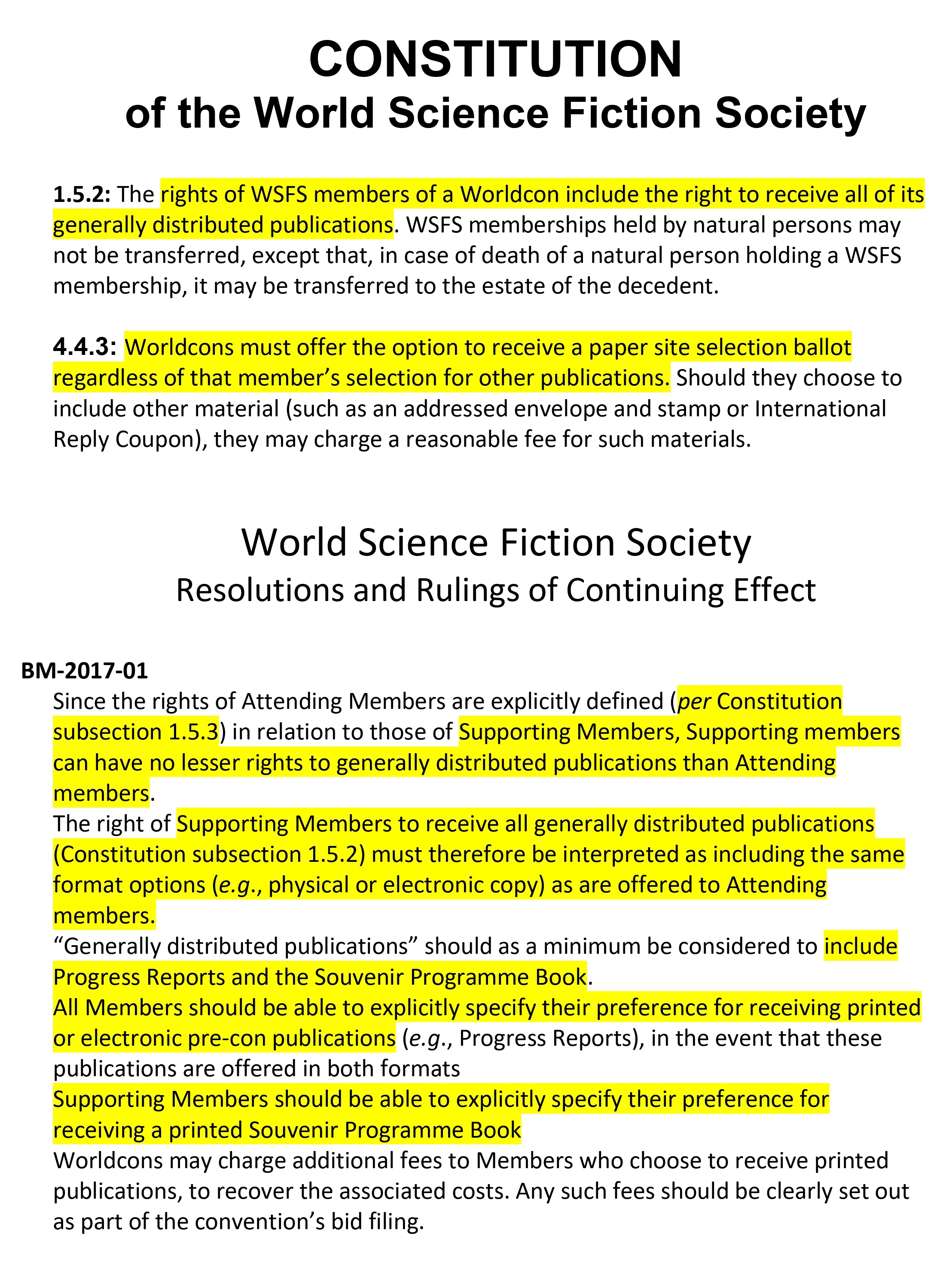
Before we properly come to Glasgow, it should be said that there has been some recent debate as to the nature and provision of Worldcon publications.  For example, there have been Worldcon publication policy concerns expressed before as well as after the 2024 Glasgow Worldcon.  But whatever are people's views, the Worldcon Constitution does have clear stipulations when it comes to publications.  The key part of the Constitution and clarification in the Resolutions and Rulings of Continuing Effect are highlighted below.

The parts of the Constitution and Rulings of Continuing Effect
that determine who has the right to which publications and in which format.


The bottom line is that both Supporting and Attending members must all have the option of receiving Worldcon publications, as a minimum, the Progress Reports and Souvenir book in whatever format they wish provided it was originally distributed and available to members at the convention in those formats.

This really could not be clearer.  (Honest!)

Glasgow is a great place to hold a Worldcon.  And the 2024 iteration started off so well, way back in 2021 at its bid stage, in proactively offering its supporters a choice between physical and digital publications.  I for one was pleased, so much so that I took out the much higher-costing 'Friend' rate so as to financially support an event that recognised digital diversity.

Alas, long story short, soon after they won their bid there were signs that they were rowing back on their previous policy. (This is the sort of behaviour you expect from less responsible politicians rather than Worldcon organisers but this is a new generation of fans.)  They did not seem to be collecting registrants' postal addresses so that they could fulfil their constitutional commitments to members and mail those who could not make the day the publications for which they paid.

As said, I am not going into all the detail; there is simply too much in outline as it is.  However early indications post-Glasgow's bid win, but before the event itself, were that Attending Members who are unable to attend would be able to ask someone to pick up their copy of the Souvenir book on their behalf.  Yet, at that time, it was uncertain whether a Supporting Member would be allowed to ask somebody to pick up a copy of the Souvenir book (let alone other materials) for them. As explained above, under the rules Supporting Members are entitled to at least the Souvenir book.

Also announced post-Glasgow's bid win was Glasgow's CoVID policy re-framed as its Disease Mitigation Policy (originally announced here glasgow2024.org/about/disease-mitigation-policy – though you may need to use the internet archive Way Back Machine to access it.).

Now, let's be clear, other than this appearing to have been written for a US-venued Worldcon and that it should have been available at the bid stage (those potentially disagreeing with the policy need to know before they take out their membership) this was a sensible policy that encouraged mask-wearing (though few did on the day).  Importantly, it said:

Members should not physically attend the convention
if they experience new and potentially contagious symptoms
which have begun within the week prior to the event.

This too was sensible, but think of the implications post-CoVID.  If you have symptoms (which might be CoVID, or flu or even a cold) then you should stay away from the event.  But what if you had already paid hundreds of pounds/dollars/euros in an attending registration fee?  Would you get your convention publications and at least the Souvenir book, mailed to you? (And let's not forget that many will have paid for air fares and hotel reservations, so their up front costs could likely be over a thousand pounds/dollars/euros. They deserve something: irrespective of the constitution and rules this is a simple question of fundamental morality. But, hey, if some are not going to abide by the constitution and rules then their ethical stance and basic morals is already clear.

Well, on a personal basis, as it transpired I did get the sniffles and I didn't go. I e-mailed the convention and got a reply and I nominated three fans as authorised to pick up my con package.  They were denied this!

Now, I was a super friend Attending member (who paid a lot), but what of Supporting Members (who paid less) and their rights under the WSFS Constitution and Resolutions and Rulings of Continuing Effect?  No surprise, as indicated the Glasgow 2025 Worldcon organisers decided not to fulfil their Constitution obligations to send Supporting Members and no-show Attending Members their convention publications in the format of their choice at which they were distributed at the convention.


The Glasgow 2025 Worldcon organisers decided
not to fulfil their Constitution publication obligations


And, to answer the question posed above, what of those abiding by Glasgow's Disease Mitigation Policy who stayed away? Well, tough, they too got nothing due to them under Constitution and Resolutions and Rulings of Continuing Effect: the Glasgow Worldcon just took their money and ran: it was blatent theft!  (Move along now, nothing to see here.)

The scale of the issue did not just affect one or two people – and if it had surely there would have been little problem in resolving matters for them – as the matter was baked into the way the organisers chose to run the convention: in the way they wanted and not as the WSFS Constitution and Resolutions and Rulings of Continuing Effect demand.  It actually affected a lot more!

Accessing the Glasgow 2024 website a couple of weeks before the event revealed the number of Supporting Members (registration.glasgow2024.org/memberships/demographics -- though again you may need to use the internet archive Way Back Machine to access it) was 2,390!  Remember this number as we will come back to it in addition to using it right now.

The cost of Supporting Membership for Glasgow was £45 (see Progress Reports 2 and 3 and the analogous category in Progress Report 1). This should have brought in Glasgow somewhere around £107,550 (about US$140,000).  Now, let's assume Glasgow had sent everyone just the Souvenir book (let alone any other title they may have been entitled to, let alone the more-than-minimum under WSFS rules) and that this cost, say £10 to mail out to the UK (certainly generous for UK) 369 Supporting members, and about £20 for overseas mailing to N. America (just a little more today (2026) since the Trump tariffs of 2025).  Given that far more Souvenir books were printed than picked up (I was told – hearsay – that a skip load were junked after the event) then the only cost to the convention would have been postage.  It is a fairly simple calculation to ascertain that Glasgow would have made a net profit on 2,390 Supporting Members of around £63,440 (US$82,500). (Aren't Supporting Members nice people.)  Apparently though, this was not enough for the organisers: as said, Glasgow just took their Supporting Members' cash and ran!


Cover of the Souvenir book that should
have been sent to non-attending registrants
but wasn't
.


Me, I was lucky and, being not unconnected with the SF community, have fan friends.  Though being denied picking up my membership pack by the Glasgow Worldcon Committee and Staff, my friends clocked all the spare copies of the Souvenir book and, with the help of a kind and understanding soul (yes, not all those running or volunteering at Glasgow were bad actors), I eventually managed to ultimately get one.

The Souvenir book was thinner compared to the others I have had from several Worldcons, and the cover misspelled the hosting nation's name, such was the Glasgow organisers' lack of care (which by now should be self-evident).

As said, we will return to Worldcon Supporting Members later.  For now, let's move on to the 2025 Worldcon.


The 2025 Seattle Worldcon
Seattle won its bid to hold the 2025 Worldcon at the 2023 Worldcon, Chengdu.  Again, at the bid stage it started off so well.  There was even an early announcement of it holding a film programme. (Recent Worldcons have been less programme diverse with fan panels increasingly dominating, and, of the seven British Worldcons to date, Glasgow was the first not to screen any films.)  Back in 2023, the only major cloud in the Seattle Worldcon sky seemed to be Donald Trump polling so well in the US Presidential polls given his border policies. Of course, the Worldcon is an international event and so this matters.  For better or worse – the US public seemed divided(?) – he won the Presidential election in 2024 taking office in 2025.  It soon transpired that travel into, and that includes returning into, the USA would be affected. Indeed, so it was, and the Seattle Worldcon – arguably wisely – took what steps it could.

However, when it came to adherence to the WSFS Constitution Seattle would become the third Worldcon in a row (after Chengdu 2023 and Glasgow 2024) to ignore Constitution stipulations but this time – presumably so as not to be out done – they would do it in a new way.


Seattle would become the third Worldcon in a row
to ignore Constitution stipulations


In Seattle's case, the part of the Constitution it chose to ignore related to the Worldcon Business Meeting.  The thing is that the Constitution states (in a number of places) that the Business Meeting must be physically held at the Worldcon itself.

The Constitution and Rules statements about the Business Meetings' location are both seemingly explicit (Constitution 1.5.3., 1.7.2, and 5.1.1.) and implicit (Constitution 4.5.5., 5.1.4. and 6.7. and Standing Rules 1.1) makes this absolutely clear.
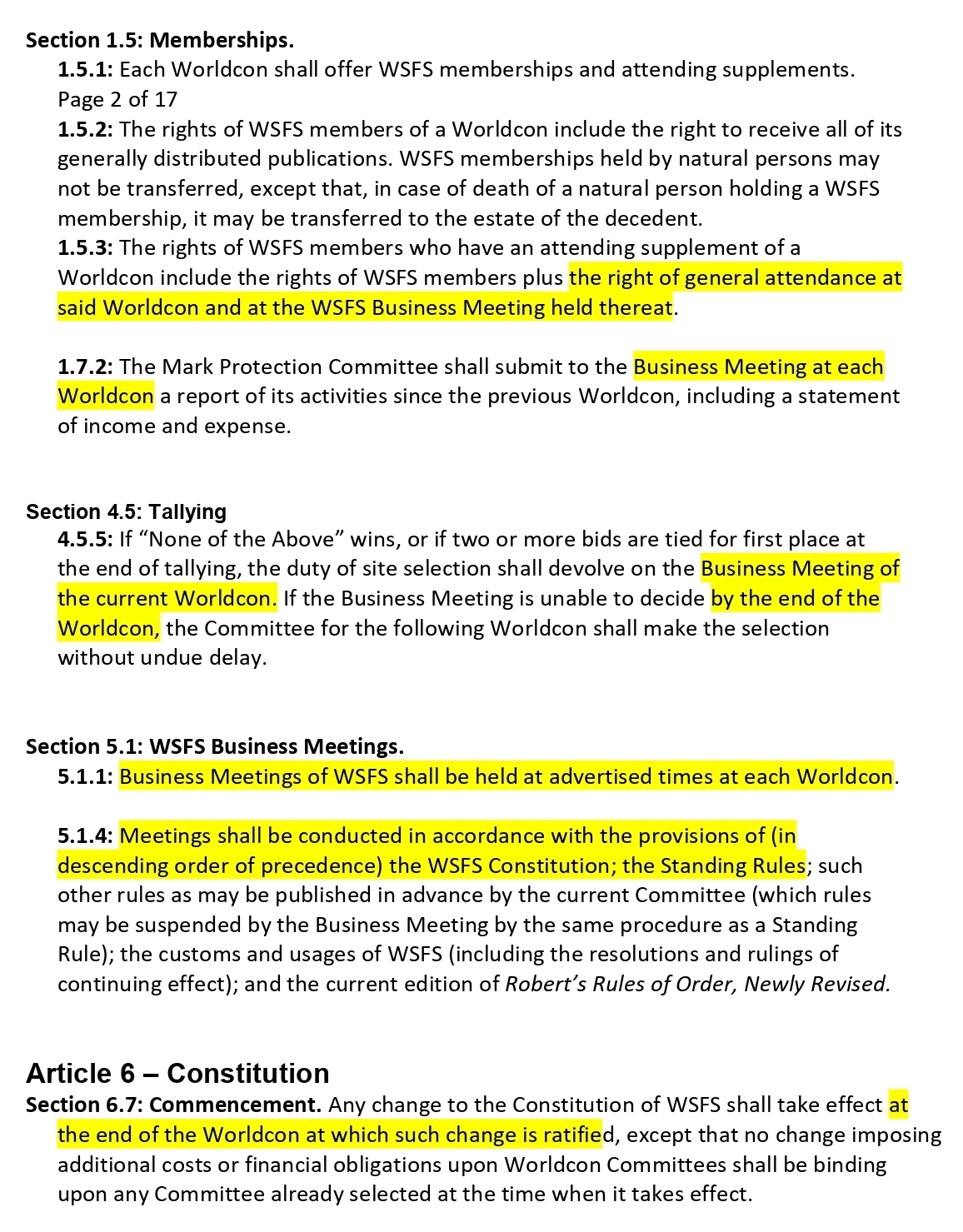
 

Holding the Business meeting actual at the Worldcon is explicit in the Constitution (above)
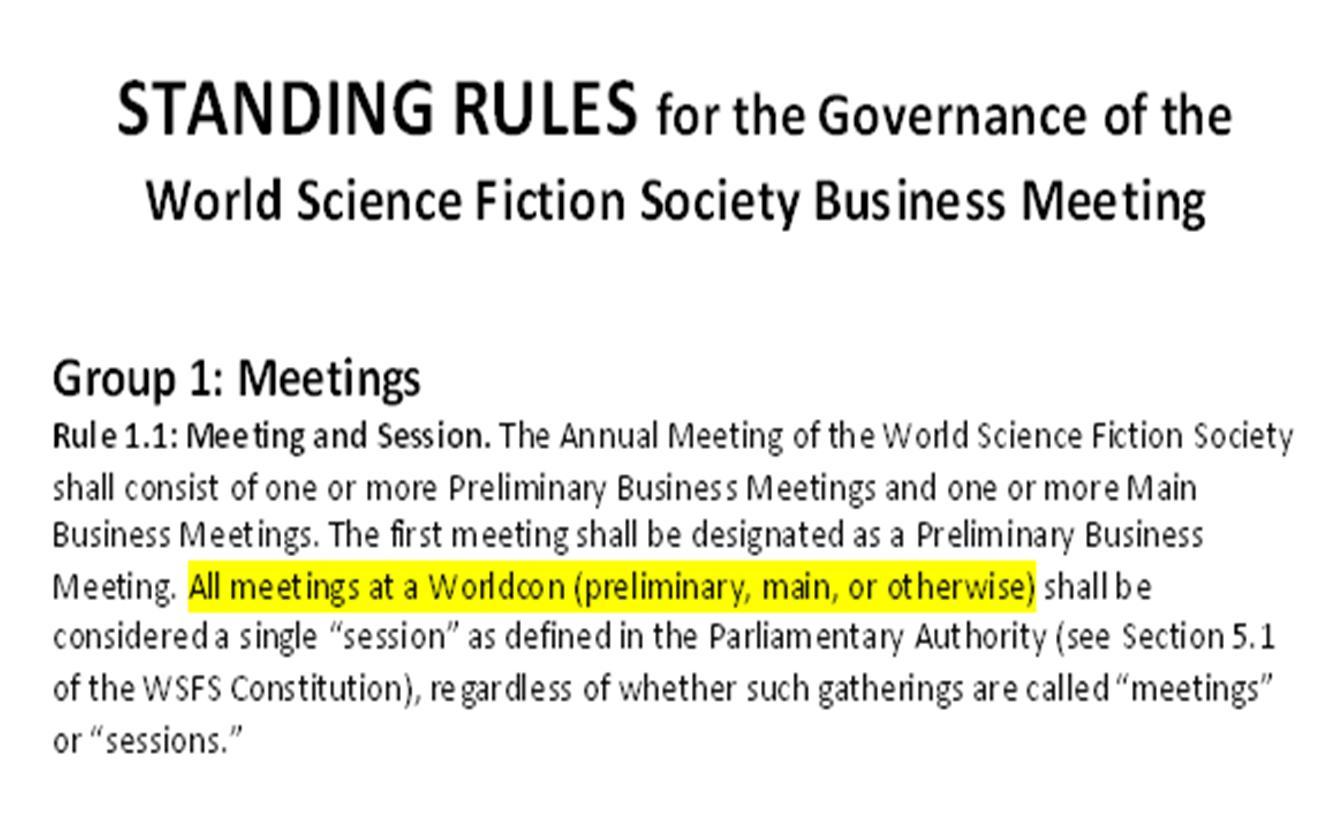
and implicit in the Standing Rules (below).


Yet despite this, the 2025 Seattle Worldcon unilaterally overrode the WSFS Constitution and Standing Rules and held meetings virtually! Ironically, they broke the Constitution they say because it enabled more people to participate in steering the constitution's evolution and for the Business Meeting not to take people away from the Worldcon itself.


Despite the Constitution, the 2025 Seattle Worldcon
unilaterally overrode the WSFS Constitution and Standing Rules


The arguments against this were primarily that if such a change was to be made then they should stick to the Constitution and change it and the Rules at the next Business Meeting held during the Worldcon. Then once the changes had been voted in, Business Meetings could be held virtually, prior to the event.

This argument against an unapproved virtual Business Meeting should be sufficient, but there were other more generic reasons put forward on social media. These included that because Worldcons were international, many folk would be in time zones that would make it difficult for them to participate in such a virtual event.

Another was digital access. Not everyone has good access to the internet. Some may use their employer's access for when they occasionally rarely need good access, but could not use this for an extensive period or, indeed, have access outside of work hours. Others lack good access because they use the internet in less demanding ways than multi-Zoom, Discord or whatever on their smartphone. Others, a small minority in the western world, simply have no personal access to the internet and access it, should they need to, through things like public library cybercafés, but you cannot use these public places to participate in virtual meetings.

One of the reasons, speciously given to break the Constitution and hold a virtual Business Meeting prior to the event, was that those who usually work on Worldcons would be busy during the Worldcon itself.

Actually, I personally have little sympathy for this last argument.  Worldcons serve the Worldcon SF community as a whole and not just regular Worldcon organisers.  If Worldcon organisers had an increased presence at the Business Meeting then the Constitution and Standing Rules would serve more the organisers' needs rather than the broader Worldcon community.

Now, this last is an important point of good governance.  In real life, a nation's management is divided up into: the executive (the part of government that executes law and policy – in Britain this is the Government's Prime Ministerial Cabinet); the legislature (the part of the government that makes laws – in Britain this is the Parliament); and judiciary (that adjudicates legal disputes and breaches – this principally comprises of law courts).  This firm and clear division of responsibilities can apply to a group of nations (such and the United Nations or European Union) and also have broadly analogous counterparts in business:  a company will have a board (analogous to the executive), shareholders (analogous to the legislature) and will have to abide by national laws as interpreted by the judiciary.

A longstanding principal of good governance is that there should be a separation of powers between the executive, judiciary and legislature. That is to say that politicians should not interfere in the way courts work and courts should not make policy instead of the government (the executive) or legislature (parliament).  So, when it comes to Worldcons the legislature is the Business Meeting and the executive is that year's Worldcon organising committee. For good governance these should be separate: Worldcon organisers should not interfere with the Business meeting especially not least if their actions go against the Constitution and Standing Rules that the Business Meeting of the broader Worldcon community determined.

In short, Seattle, in unilaterally going against the constitution, were on a number of levels failing to adhere to good governance and raised the finger to average fans.


Seattle, in unilaterally going against the constitution,
raised the finger to average fans


One of the first matter's the Seattle virtual Business Meeting addressed on 4th July 2025 was the question of whether the meeting itself was actually legal under the Constitution and Rules?  To that end they held an online vote. This was an interesting if not a Kafkaesque moment: how could an entity not established as being Constitutionally legal declare itself legal outside of a Business Meeting that was already officially legal? Shades of bootstrapping (or for an SFnal example, By His Own Bootstraps)!

The vote went 102 for and 46 against: roughly two-thirds were in favour of declaring the meeting legal, with nearly a third against: that is a non-trivial minority who were clearly uncomfortable with the notion of Seattle's virtual Business Meeting's legality. So it is hats off to the one third abiding by the WSFS Constitution, and incredulity to the two-thirds.  Worldcon organisers had effectively undertaken a coup against Worldcon fandom at large.


Worldcon organisers had effectively undertaken a coup
against Worldcon fandom at large.


Remember, as noted earlier, Worldcons these days are more than the just 148 people at the Business Meeting. This is a small number and it remained small the subsequent weeks across all Seattle's Business Meeting sessions.  As what is effectively the US Science Fiction book-trade magazine Locus reported, "average attendance at the various Seattle virtual meetings was about 160".

Irrespective of the Business Meeting's 'legality vote', a screenshot of the Constitution and Standing Rules relating to the Business Meeting (was given depicted earlier) you can see for yourself..  So, do you agree with Seattle's Presiding Officer that the virtual meeting was allowed under the Constitution?

With all this going on, you would think that there would be a huge reaction from Worldcon fandom. Well, there hasn't, and yet there has… but it has taken place quietly!  To understand that, you need to have an idea of the numbers involved in various parts (organisers, average attenders, business meeting participants etc) of the Worldcon community.


The Worldcon community: Who and how many
When considering the Worldcon community reaction, it is important to recognise what is the Worldcon community and who, as well as how many, participate in developing the Worldcon Constitution and Rules.

In terms of those enjoying Science Fiction there are literally millions in the Anglophone and European nations. In terms of Worldcon participation (those that regularly and significantly contribute to the Worldcon community) the number is much less, far fewer who enjoy SF go the Worldcon.  As previously noted broadly speaking most Worldcons these days see in excess of 5,000 attend.

Again, very broadly and loosely speaking, attendance type at a Worldcon is indicated a number of ways. For example: a year before Glasgow 2024 some 3,000 had registered and these could largely be said to consist of:
  - Worldcon regulars both domestic and overseas
  - Brits who only go to UK Worldcons

Over the subsequent year, those that joined were largely British Isles and then western Europeans who thought they would either give the Worldcon a try or combine Glasgow with a tourist holiday.

A little over a month before the event, as revealed by the Souvenir Book (never sent to paid up Supporting Members or no-show Attending Members) the membership stood at a little over 6,000 with roughly (actually almost exactly) half from the United Kingdom and a similar number from N. America (with those from the USA alone numbering a tad over 2,800). (The Worldcon is usually very Anglophone.)

On the day 9,872 were registered of which 7,081 were confirmed as physically attending. The remainder were (in order of decreasing numbers): Supporting Members (2,390) and then Virtual Members (600+) along with no-show Attending Members (remember if you exhibited CoVID-like or flu symptoms folk were asked not to attend).

There are quite a few numbers here, but another way of looking at it is to look at the Worldcon's size compared with numbers attending the Business Meeting and with some meaningful interest in it.  The former can be estimated for some of the Business Meeting vote counts and the latter from views of Business Meeting videos on YouTube.

Pulling it all together we get the following picture diagrammatically portrayed below.
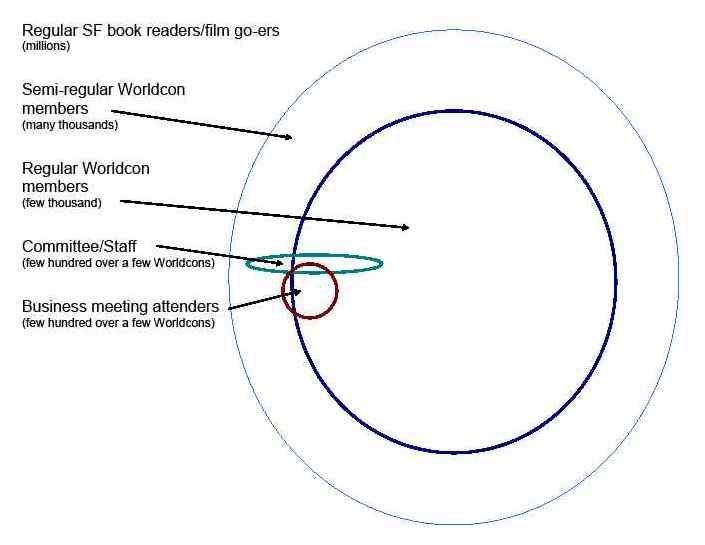

Very rough estimation as to how involved Worldcon members are in
the Business Meeting and evolving the Constitution and Rules.

Even though it is hard to get a highly accurate picture, a broad picture of numbers clearly emerges.  This reveals that a tiny minority of those that join up to Worldcons actually go to, let alone contribute to, the Business Meeting. By a small minority we are talking about 2 – 4% of those attending a Worldcon and 1 – 2% of those that join (which also includes in order of decreasing numbers Supporting Members, Virtual Members and no-show Attending Members).


A tiny minority of those that join up to Worldcons
actually go to, let alone contribute to, the Business Meeting.


In short, a tiny minority of those involved in Worldcon actually involve themselves in the Business Meeting and the evolution of the WSFS Constitution and Rules. The majority just trust them to get on with it, and on that 'trust' basis many hundreds are happy to take out Supporting Memberships.

Indeed, if the reason was for the Seattle to encourage a greater participation in the WSFS Business meeting, it was not a resounding success.  Remember the earlier vote on Seattle's virtual Business Meeting's Constitutional legality? Well, just 148 participated. Seattle on the day saw 7,402 warm bodies and 835 Virtual Members and the Worldcon long list on Wikipedia gives a figure of 7,739 which excludes walk-in day memberships. This means that the number of people participating in the initial Seattle virtual Business Meeting represented some 2% of the convention's membership: Not exactly a major improvement, if an improvement at all, on usual Business Meeting participation.

The tail is wagging the dog.

The question then springs to mind is why is there only such a small minority so engaged with Worldcon matters?

Without going into detail (this article is already way too long), my own view is that most people are content to let others handle this and to trust them that they will do a reasonable if not good job of this administrative dimension to Worldcons.

Remember, broadly speaking roughly just half of those attending a given Worldcon are regular Worldcon attenders and half either only attend a Worldcon when it comes their way or it is their first time. And of those regularly attending a good number do it to catch up with old friends, or go because they are professionals (writers, editors, etc.) who have no skin in the fan politics game.  For first time participants the programme and exhibitions are the key attractions.  Of course, being first-time participants, these folk know nothing of how the Worldcon programme has evolved over the decades with the recent decline in past big name professionals on the programme (other than in coffee table meets), the decline in talks, the eradication of the film programme and the huge growth in panels (of varying and mostly limited quality).

I myself am an occasional Worldcon member.  I have attended several over nearly half a century of con-going: 5 UK Worldcons (excluding Glasgow 2024 for which I was a Friend member, could not go and received zilch in the way of publications such was the mean-spirited, unfannish nature of its lead organisers), one mainland European; one N. American and one Australasian (it would have been two but my putative second Australasian Worldcon was CoVID lockdown year and not being on the internet I was digitally isolated – not the con's organisers' fault).  So, I am not a regular, but neither am I a one-timer and I do keep a vague eye on Worldcon, among other, SF fan matters.


A committee can put on a shitty Worldcon
and still half the folk would enjoy meeting old friends


What it boils down to is that a Worldcon organising committee has to perform very badly in advance of the event for people not to join a Worldcon; a committee can put on a shitty Worldcon and still half the folk would enjoy meeting old friends, conducting personal business and so forth.  So when a Worldcon has capable but only mediocre organising, then that's actually quite a win especially given the organising fans are all volunteers.

What it also means with such a small minority participating in the Business Meeting, it takes just a very few bad actors to derail things.


It takes just a few bad actors
to derail things


And then the way Worldcon is structured means that there is – amazing as it may seem, but true – there is no-one actually responsible for good governance and adherence to the Constitution and Rules!

Governance is only maintained by the Business Meeting.  The WSFS officers of its standing committees have specific responsibilities connected solely with their respective committee's remit.  Nobody, other than the Business Meeting participant, has this responsibility. The bottom line is that if a Worldcon decides to break the Constitution and Rules (be it changing their bid's date and venue, altering the way the Hugos are run, failing to deliver on their publication commitments, or even changing the very nature of the Business Meeting without prior Constitution and Rule change) there is nothing stopping them.  This is why the organisers of Chengdu, Glasgow, Seattle and (now it seems) the seated Worldcons, get away with it.

Add this lack of governance control to the small number involved in Worldcon constitution and it is quite surprising that it has taken till now in the Worldcons almost getting on for a century's history (well, not quite but we are getting there) for there to be a string of Worldcons to trample all over the Constitution.  Most folk are happy for such matters to be handled by a minority and trusted to get on and do a reasonable job.

Now, there are a number of barriers to fans getting involved in the Constitution.  Not least of these is that if one wants to change the Constitution one has to get a few people to come together, present a well-reasoned case, then put it to one business meting to change the Constitution and then attend next year's Business Meeting to get it ratified. Few fans will attend three Worldcons in a row to do this.  Fewer still the commitment and desire to involve themselves.   Now, I am not having a pop at these folk; why should anyone have to make such a commitment?

Of course, this provides an argument for having virtual Business Meetings in advance of that year's Worldcon.  But even if this is a reasoned argument, it is not an excuse to break the Constitution and unilaterally decide to hold a virtual Business Meeting – the Constitution needs to be changed first!

This brings us back to the other key argument for having a virtual meeting is the aforementioned one of allowing those involved in Worldcon organisation to attend the business meeting.  This is arguably not good for separation of powers reasons for good governance that was also made earlier.

So, what with:  the failure of the Hugo Award administrators of 2023 Worldcon (Chengdu) to follow the Constitution and Rules as to how that year the short-list would be managed;  Glasgow's 2024 failure to give Supporting Members (and no-show Attending Members) their Constitutional due;  and Seattle turning it back on the Constitution and unilaterally deciding to make the Business Meeting virtual ahead of the Worldcon… what has been the reaction?


The Worldcon community reaction
The reaction to the Chengdu Hugo Award debacle only emerged once folk realised something was amiss.  As discussed in the previous section, only a tiny minority of Worldcon regulars and semi-regulars actually closely involve themselves in Worldcon Business meeting and associated matters.  However, not being closely involved does not mean uninterested, or uninformed.  There are more in the broader Worldcon community, outside of Business Meeting regulars, who keep an eye one WSFS matters and a few are prepared to take a very close look at things like Hugo nominating statistics.  As noted by Dave Langford's Ansible, those raising an eyebrow initially included Alpennia, Cora Buhlert and Camestros Felapton among other thoughtful souls.

Long story short, there was some investigation (notably here) and this prompted some of those who run WSFS to act.  At the end of January 2024, the Worldcon Intellectual Property announced resignations (Dave McCarty, Kevin Standlee as chair), censorings (McCarty for public comments and Hugo administration actions, plus Chengdu co-chairs Ben Yalow and Chen Shi for the actions of that year's Hugo administration over which they presided.).

Now, this action is important for, as we shall see, those effectively running WSFS usually do not act, as I have just noted, citing that the WSFS structure has no mechanism for ensuring adherence to the Constitution and Rules let alone disciplinary mechanisms. (As an aside, someone else involved in WSFS said something similar (fairly accurately in my view) at the time and was reprimanded by the same people!  Go figure.)

Of course, things are never that simple. Worldcon Intellectual Property (W.I.P.) is the California non-profit corporation that holds the service marks of the World Science Fiction Society including the mark 'Hugo Award'.  So technically, it is not synonymous with WSFS but is an official aspect of it. The resignations were not from WSFS per se but the W.I.P. (We will come back to WSFS shortly.)

And, there was outrage over the Chengdu Hugo debacle in fandom, especially Worldcon fandom.  Fan reaction appeared on some websites comments' sections (such as here.  It even spilled over into the national press.

Meanwhile, there were pre-convention concerns over Glasgow's publication policy (including an article elsewhere in SF² Concatenation.

I myself tried to instigate debate in a number of places. This included trying to get one going on the Glasgow publications issue in a Hugo-winning fan podcast.  One of the podcast's team kindly replied.  There is a screenshot of the script of their response below.
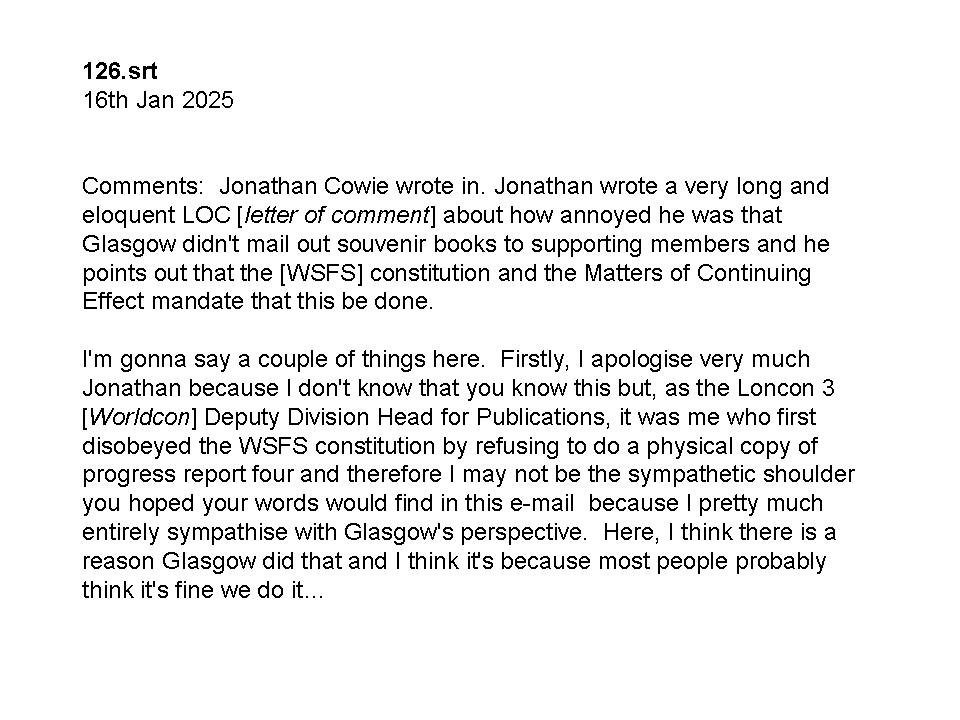

Transcript of the SF podcast response to Glasgow concerns.


This was a little disappointing especially as one of them claimed to have disobeyed the constitution because 'most people probably think it's fine we do it'. You really can't make this stuff up.


Disobey the constitution because 'most
people probably think it's fine we do it'


Yet, such is the level of debate (or lack thereof) in the Worldcon SMOF echo chamber that, as here, some folk think they have disobeyed the Constitution when they haven't!  In this instance, Loncon 3 (the 2014 Worldcon) did not break the Constitution as the podcaster (and Loncon publications officer) thought.  Remember the Constitution earlier?  Its paragraph 1.5.2. states that only 'generally distributed' publications need be sent and this is affirmed in the Resolutions and Rulings BM-2017 that Worldcon members only have the right to 'generally distributed' publications. Because Loncon's Progress Report 4 did not have a paper version distributed, there is no Constitutional requirement for a paper copy to be sent Supporting and no-show Attending Members.  Yes, even the person responsible for a Worldcon's publications is blissfully unaware of what the Constitution says regarding publications let alone the Resolutions and Rulings of Continuing Effect.  This is the level of some of the debate and some Worldcon fan group think.  Mind you, not that this would have affected that person's behaviour as apparently it is alright for Worldcon organisers to break its constitution if they feel that 'most people probably think it's fine we do it'.

You really can't make this stuff up!

Meanwhile, a feel for the fan reaction to Seattle Business Meeting going virtual can be found in the comment of various SF fan site posts (such as here).


So, what to do?
Well, one perfectly understandable reaction would be to do nothing.  After all, just as the Worldcon programme is in decline, the event becomes more one of an annual get-together.  It is already clear that people will go to a Worldcon even if it is shitely organised.

For those wanting to do something, then it needs to be through the Worldcon's business meetings over the course of two or three years so that it includes disciplinary actions in the event of a Worldcon deviating from the Constitution.

The best people to take this forward are the members of the various WSFS committees: most of those go to most Business Meetings. But so far they seem content to hide behind the 'it is not in our committee's remit' argument.  While this may well be true it is far from a 'can do' attitude and close to pure apathy.  Let's be clear. There is nothing stopping these folk from encouraging debate in Worldcon business meeting circles and then presenting options that rise up from such debate. One might easily envisage the Constitution being changed to formally give members of some of the committees the right to undertake disciplinary action ranging from a quiet word to a Worldcon Chair, if they were about to break the Constitution, to full-blown public censuring for those Worldcons that do break the constitution and rules including having a note of that happening appended to that Worldcon's entry on the formal Worldcon listing.

But as this debate is not being encouraged by the powers that be, let alone taking place, this is probably wishful thinking.

This brings us back to the 'do nothing' response.

Well, not quite.  There are signs that hundreds of regular Worldcon fans are in fact doing something!

As said, Glasgow's 2024 website just before the convention said that it had 2,390 Supporting Members.  The following year Seattle only had around 1,170 for the equivalent WSFS Only membership grade! WSFS Only is the nearest equivalent membership grade to Supporting Membership but without the protection afforded (or not as it turns out) by the WSFS Constitution and Rules

Whichever way you cut it (allowing for proportionality of each convention's respective total membership) Supporting Membership is way down.  Fans are voting with their feet.  Willingness to support the Worldcon this way is evaporating.


Supporting Membership is way down.
Fans are voting with their feet.
Willingness to support the Worldcon this way is evaporating.


The income lost because of this is the order of several tens of thousands of pounds/dollars!


I myself will never
friend-support a Worldcon again.


I myself have said that I will never friend-support a Worldcon again and, added to that, I join those that are no longer taking out supporting memberships for the Worldcon.  If I do ever go again (I haven't flown for a decade and am not sure I ever will for quite separate -- climate -- reasons) I can always register on the day, or perhaps even not bother to register at all.  After all, if Worldcons are just going to become get-togethers, one can meet friends in the surrounding bars and still attend publishers' parties (these are not run by the Worldcon).  Not being able to attend big-name author interviews (especially of those who have fewer professional years ahead of them than behind them) that aren't taking place, or not seeing independent SF films from around the world that have never had a general release and which are no longer screened at Worldcon, is not missing out.  Not being able to nominate or vote on the short-list for the Hugo is not a great hardship.  There are other SF conventions, other SF events, groups to meet, local fans to talk to, books to read and films to see, book launches to attend and so forth.  I think somehow I'll get by, and I do have my fond memories of earlier Worldcons.  The new generation of SMOFs cannot take those away from me and they can carry on trashing the Constitution as they wish.

So long, and thanks for all the fish.

Jonathan Cowie


[Up: Article Index | Home Page: Science Fact & Fiction Concatenation | Recent Site Additions]
[Most recent Seasonal Science Fiction News]

[Convention Reviews Index | Top Science Fiction Films | Science Fiction Books]
[Science Fiction Non-Fiction & Popular Science Books]

[Posted: 26.1.15 | Contact | Copyright | Privacy]