Convention Review
The 2024 Glasgow Worldcon
A Worldcon For Our Futures
The 82nd World Science Fiction Convention
8th – 12th August, Scottish Event Campus, Glasgow.
Peter Tyers reports and gives his personal impressions of the community.
Introduction
Glasgow 2024 subtitled itself ‘A Worldcon For Our Futures’ though without explaining what they meant by that. Others were therefore tempted to qualify the subtitle, albeit unofficially, with their own views, on the lines of ‘A Worldcon For Our Futures - Provided You’ve Got A Smartphone’ (see later for comments on their publications and communication), ‘A Worldcon For Our Futures - Though Perhaps Not Disabled Futures’ (some with accessibility requirements were unimpressed), ‘A Worldcon For Our Futures - Though Where George R. R. Martin Cannot Actually Speak To Anyone’ (see later for comment), and ‘A Worldcon For Our Futures - But You Must Wear Purple’ (referring to the convention requesting that members should only buy the convention T-shirts in purple - the chair’s favourite colour).
After the con(vention) was over I had dinner with a friend, one who, like myself, has attended many cons over the years (Worldcons, Eurocons, national cons, major annual cons, and smaller regional cons, on both sides of the Atlantic and, indeed, on other continents). ‘How many would you give it out of ten?’ I was asked and I decided ‘about five’. ‘That many?’ came the reply. After some discussion of our experiences of both this Worldcon and other cons, we agreed that maybe three to four was about right. And that is nothing for Glasgow to be proud about.
A three to four
out of ten convention
Dates and Attendance
It ran from Thursday 8th to Monday 12th of August, 2024 and the Guests of Honour (GoHs) were Chris Baker (aka Fangorn) (artist), Claire Brialey & Mark Plummer (fans), Ken MacLeod (author), Nnedi Okorafor (author), and Terri Windling (author, editor, artist, and folklorist). In addition there were three Special Guests: Tendai Huchu (author), Tanya DePass (games), and Three Black Halflings (podcaster trio Jasper William Cartwright, Olivia (Liv) Kennedy, and Jeremy Cobb).
I have not found final attendance figures published by the event itself but Wikipedia reports 10,000 members in total, of whom 7,300 attended in person and another 600 virtually - I suspect there is some rounding in these figures. Various figures were quoted at the time, more on the line of ‘aren’t we doing well’, and various others have appeared since in various articles. Wikipedia’s seem near enough. (SF² Concatenation's reportage on attendance here.)
The Site
The convention was held at the Scottish Event Campus (the SEC) in Glasgow, on the north bank of the river Clyde. It was centred in the shed-like SEC Centre (Scotland’s largest exhibition centre). On the ground floor the Centre was home to the enormous Hall 4 and slightly smaller Hall 5, between them housing many of the fannish facilities, whilst the programme used the smaller Hall 1, Hall 2, and Loch Suite. The programme also used the smaller rooms on the ground floor and the several meeting rooms on the smaller mezzanine floor above. It also made use of the Crowne Plaza Hotel, next door, where it used the Caste and Argyll Suites on the ground floor and the Islands Suite on the floor above.
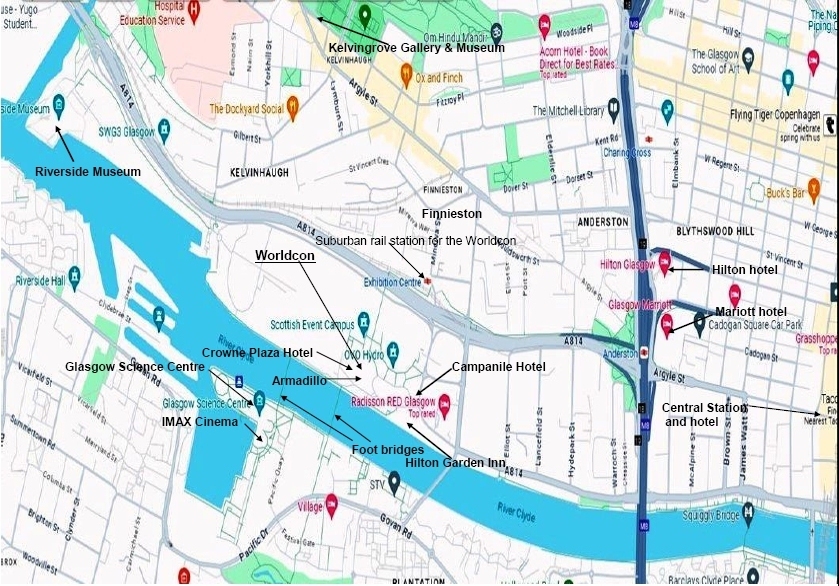
Getting between the Centre and the hotel was by far easiest done at ground level, by simply walking out the door of one and across to the door of the other, a minute or so. It was also possible to move between buildings at the upper level, though this was much(!) more difficult. There was an escalator and lift in the SEC Centre, following which you walked along a long, windowless corridor to reach the rear of the Armadillo, took a 150 degree right turn and along another windowless corridor, through a set of doors and a 180 degree left turn, then along another windowless corridor with several steps down part way along (there was a special, small lift for those needing it), then through more doors to the upper floor of the Crowne Plaza and its Islands Suite, and lastly a staircase and a lift back down to the ground floor. Yes - it was awkward! These windowless corridors were either suspended in the air between the buildings or bolted onto the sides of the buildings. Whoever the architect was for that ‘solution’ should be ashamed of themselves - it was a terrible lash-up. Those with disabilities were strongly advised to travel at ground level!
The major (i.e. large) programme items were held in the SEC Armadillo, the building which houses the three-thousand seat Clyde Auditorium. The two names are synonymous; the Clyde Auditorium became known as the Armadillo because its design is reminiscent of one, though it is supposed to represent the prows of a line of ships (this was ship-building country!). Personally, I like it.
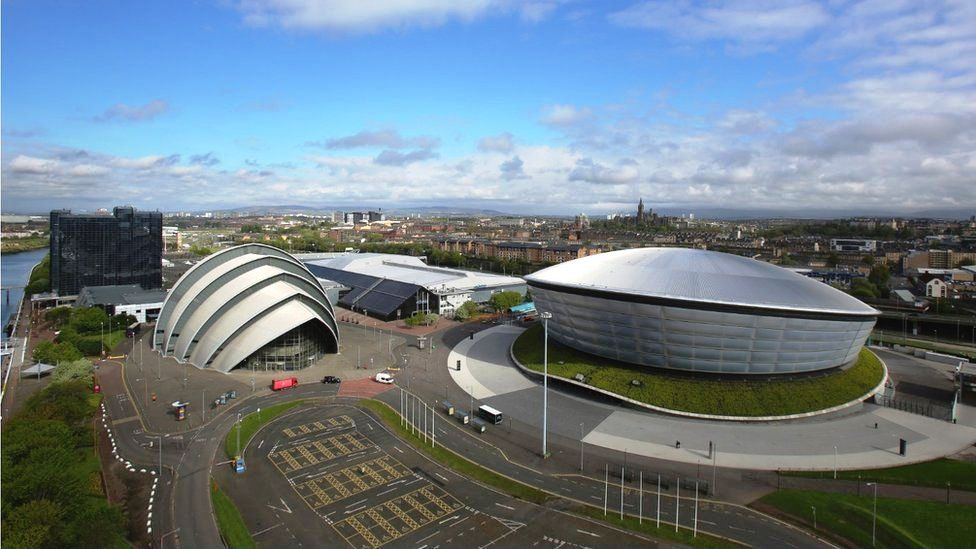
Scottish Event Campus. Front right, the OVO Hydro.
Front left, the Armadillo. Centre behind, Scottish Event Campus halls.
Behind the Armadillo is the Crowne Plaza Hotel.
The programme also made use of a few rooms in the Village Hotel, which meant a walk of a few minutes and crossing the Clyde by means of the pedestrian Bell’s Bridge. I never got to anything there. However, it did not make use of the OVO Hydro (a sports arena and concert venue holding up to fourteen thousand), which was the other large building on the SEC site.
The con made use of the eight hotels on/near the SEC site, all just a few minutes walk away. These were the Crowne Plaza, Courtyard By Marriott, Campanile, Hilton Garden Inn, Radisson Red, Moxy, Premier Inn, and Village hotels. It also listed many others in the city centre and, in conjunction with the Glasgow Convention Bureau, often these also offered special convention rates.
I stayed in the Premier Inn, next to the far end of Bell’s Bridge, a mere five minutes easy walk from the SEC Centre’s doors. As with Premier Inns in general, I found this to be a perfectly good hotel though, as the chain does not do deals with events, it did not have a convention rate. Due to uncertain plans, I had booked fairly late but some folks who had sensibly booked much earlier got their bookings for nearly half the price I paid (there is a lesson there). It proved to be a good choice as I kept bumping into friends who were also resident; there was always somebody to share a breakfast table with and also with whom to enjoy a quiet end-of-evening drink in the bar. The hotel had a sizable Costa coffee shop; plenty of space, a quiet place away from the bustle of the con, and a reasonable range of snacks/light meals during the day.
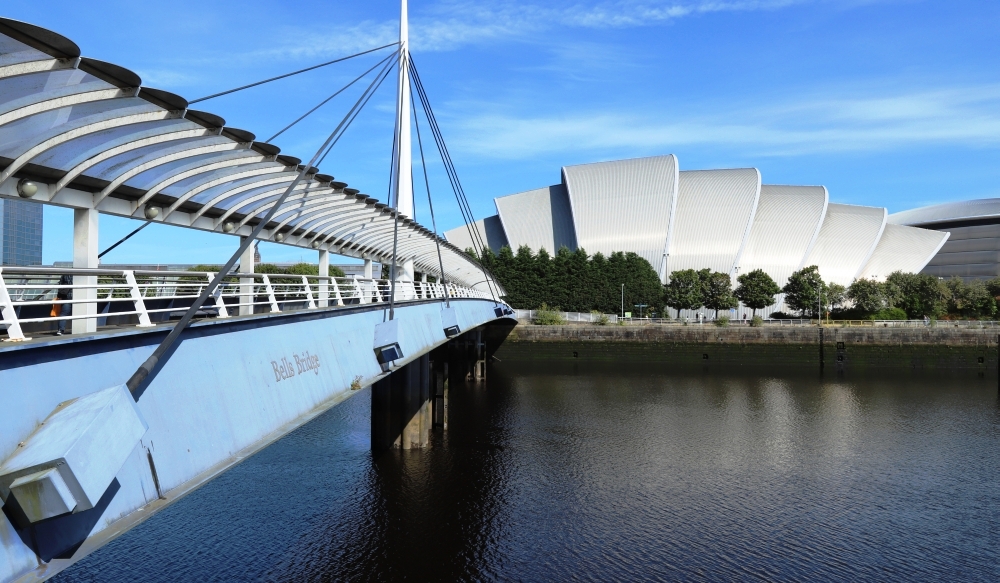
Bells Bridge. This and all subsequent photographs were taken by Peter Tyers
with a press pass from the 2024 Worldcon.
At this point I will mention the ‘facilities’, or restrooms as our American brethren would call them, particularly the lack of them at crucial times. The Armadillo holds three thousand people so did the architects not understand that the demand would be very high during the intervals? The queues were awfully long! I cannot speak for the Ladies (though they often had long queues), but I noticed that there was an overall shortage of WCs for the Gentlemen, particularly in the SEC Centre. Again, did the architects not understand that there would be periods of high demand, such as many programme items ending at the same time in a conference centre?
For those with disabilities I gather it was particularly bad, with complaints that often the appropriate toilets required the use of a special key, known as a RADAR key. There were a few available from the Information and Accessibility Desks but you had to go and get one and then return it afterwards, which was a time-consuming and onerous task. It did not help that at least one person decided to make life easier for themselves by keeping a key for their own personal use, with no thought as to the needs of others. I expect better behaviour in fandom!
You can research the RADAR (Royal Association for Disability And Rehabilitation) key scheme, now called the National Key Scheme but still mostly known by its old name, but briefly it provides over nine thousand specially equipped toilets in public places across the UK and which can only be used by key holders. These keys cost £5 or less and can easily be purchased in some pharmacies and online so I would recommend that anyone who needs one buys their own (and keeps it with them!). Unfortunately, this did not appear to be mentioned in the con’s Accessibility information. Incidentally, for those travelling to the continent, there are similar schemes there.
Run up to the Convention
Before telling you about my time at the con and how I thought it compared with previous ones, both Worldcons and otherwise, I need to make it clear that any convention is the result of much hard work by not only the organising committee but all those who participate and all those who help before, during, and after the event. In the case of a Worldcon, that is a lot of people, who do a lot of work, and do it over a long period - and my thanks go them for all their efforts. That, though, does not mean I thought it all went well, nor that I thought things were necessarily done as well as they ought to have been.
As my overall view might seem a little bleak, I would recommend that you also read reviews from others, some of who may be looking at the event with younger eyes, be less experienced and have less to compare it with, and who might simply take it for what it was. I do not mean to imply that I had a terrible time, for I did not, merely that so much did not impress me and it left me fondly remembering earlier and, in my opinion, better run conventions. It is quite clear from reviews by others that they had a very good time, albeit sometimes with reservations. And it should not come as a surprise that the great majority had a good time – put that many fans together at an event like that and they are bound to enjoy themselves!
When joining the con, first I had to register interest and only then could I buy a membership; normally it is just one step and I could not see why they had made it two! WSFS (the World Science Fiction Society) is entirely composed of those who are members of the con; if you are a member of the con then you are, by definition, also a member of WSFS – and vice-versa. For this convention the memberships were separated, i.e. you had to buy a con membership and a separate WSFS membership; however, the way it was set up you could only purchase them both together, i.e. you could not buy one but not the other. This seemed cack-handed but I assume they had a good reason for separating the two but then ensuring that you had to buy both together, but I do not know what that reason was.
Throughout the run-up to the con, I found the website less than easy to navigate. Grouping things together into an intuitive menu structure is not always easy and designs can tell you a lot about how the developers see things. However, menus should always be designed from the perspective of the untrained user; one who does not know (nor should need to know) how the organisers see things, but how they, as users, can easily find what they are looking for. This one did not impress (well, not favourably).
Given that most members were travelling long distances, often between continents, there was not a lot of travel advice offered: not even much on how to get from the airport to the SEC site. There had been a few early attempts but these had soon disappeared, possibly for good reasons as some of the early advice was far from helpful; such as recommending arriving in the UK at Manchester Airport (despite it being generally regarded at the time as possibly the UK’s worst airport), or implying that getting through Heathrow Airport would be quick (in reality there had been many complaints from holidaymakers of, and indeed national news items on, the process taking several hours). I was pleased to see, though, that mention was made of flying into other major European airports and then connecting to Glasgow, especially if you were careful to use airlines belonging to the same groups.
At the Convention
I arrived a couple of days early, so as to get over any travel hassles and to relax before it all kicked off. The site had changed a little since my attendance of Intersection in 1995, an event I had much enjoyed. The SEC Centre had a new bar, the Clydebuilt, but it only offered squirty keg beers and at £7.60 (US$10) a pint – not an auspicious start. Furthermore, the whole building was cashless – you used cards or you got nothing from anywhere, including the food trucks!
When I got there, set-up had obviously started but none-the-less the building was surprisingly quiet – there were more members of the public in evidence than there were con staff, and these were visiting the ‘Beyond Van Gogh’ exhibition which was running in Hall 3 before, during, and after the con.
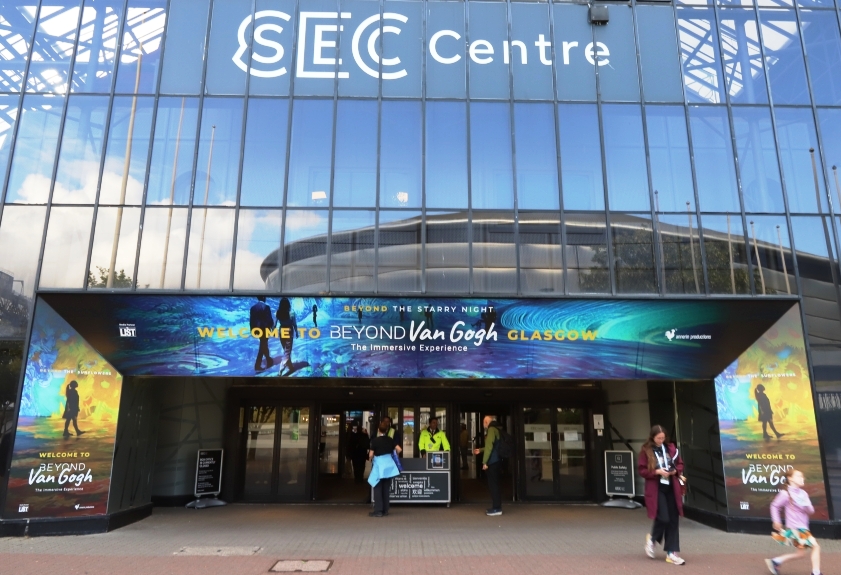
From my first entry to the con venue, I experienced the bag checking which was to be endured by everybody every time they entered the SEC Centre or the Armadillo, and sometimes the Crowne Plaza, by any entrance. I found the security people to be very friendly and efficient at their jobs, though it was not a good idea to try messing them about. In Issue 1 of The Unicorn (the con newsletter) it said ‘Bag Checks. Yes, we were surprised too. The SEC first mentioned them on Tuesday morning.’ This surprised me because bag checks are mentioned as soon as you enter the SEC’s website – had the convention organisers (aka the committee) never looked at their host location’s website? I was later to wonder – quite often – what else the committee had not looked at.
Thanks to SF² Concatenation I could claim press credentials and decided to put this to use, especially as being a ribbon-wearing press photographer should stop some of the over-eager gophers (and, it turned out, official security staff) from such errors as ‘you can’t take photos in here’ for no apparent reason. It also meant that my first event was the press briefing. Con chair Prof. Esther MacCallum-Stewart welcomed us, we had short introductory speeches from a few people, and vice-chair Meg MacDonald finished with a short Q&A. Unfortunately Esther missed a golden opportunity to properly explain to the professional press just what an SF Convention really is, what fandom is, and to define for them what it is all about. It is little wonder that the Press usually gets it wrong and this was illustrated when, shortly afterwards, a member of the professional press asked me if I had been to many of these ‘Comicons’ before, having failed to realise that he was actually at a Science Fiction Convention (perhaps he thought that all conventions were called ‘Comicons’?). Furthermore, he then asked me where he could find Trekkies as he wanted his photographer to get photos of the weird folk. I tried to correct him on both points but I do not think he was interested in accuracy, he just wanted his standard Press misinformation story.
It is little wonder that the Press
usually gets it wrong
Unfortunately, this had meant missing ‘Dune! The Musical’, which looked much more fun. Indeed, I concluded by the end of the con that my press credentials had mostly been a waste of time. I made a number of visits to the con’s Press Office, which I found to be of little use. I do not blame the staff there as they were clearly doing their best in unfortunate circumstances; they were clearly very hampered by the lack of response from much of the convention’s organisation, they just were not being told anything. They were so often trying to get answers to ‘this’ or answers to ‘that’ but obviously not getting any response. It was clear to me that communication within the organisation as a whole (not just with the Press Office) was not good. Email was the committee’s chosen method but it was not working well as emails (in general) were often not responded to, and the frustration was obvious. Likewise, phones were not answered, text messages were not replied to, and voicemails were ignored. Quite frankly, I am surprised they did not resign in protest at the lack of support they were getting. And it was far from just the Press Office that was suffering; throughout the con I kept finding staff who needed answers but could not get any. ‘Just when do we open the doors?’ ‘What are we supposed to do with a queue this long as it is blocking the main corridor?’ ‘Can we let people with accessibility needs in first so that it is easier for them?’ ‘I know we’re the Information Desk but they haven’t told us anything about that.’ As shall be seen, poor communications was to be a recurring theme.
Programming had decided to arrange most of the programme items on an 90-minute time period rather than the usual 60-minutes. Whilst most items were still about 50 minutes long, the idea was to allow a whole half hour extra to get from one item to the next, thus avoiding the usual mad dash from room to distant other room and consequent failure to get into desired items. This worked to an extent but as many of the rooms proved smaller than needed and there were over seven thousand of us, many rooms still filled very quickly. Dash on to your no. 2 choice? Nope, that was full as well, and quite often likewise for other choices. So it transpired that the 90-minute grid did not solve the problem of rooms being full. Indeed, if you could not get into anything, you had to wait ninety minutes rather than sixty minutes for the next chance, and that did not feel like an improvement. Over the course of the five days, I rarely managed to get into my first choices, often failed to get into my second choices, and even third and fourth choices sometimes proved difficult. Consequently, there was much interesting looking stuff that I missed; indeed, I came to think of this as the ‘could-not-get-into-that-item-either convention’, an opinion I heard from others.
And the panels, I found many of the items, mostly the panels, that I did get into to be disappointing and soon left. Sometimes that meant I could try another panel (and often be disappointed by that one as well). All too often panels drifted from the posted topic, resulting in more of a general discussion, indeed sometimes just a chat or waffle about vaguely associated topics. Moderators were often not on the ball! Added to that, some people clearly had little of interest to say, leaving me wondering why they were on the panel (or even how they got on it; was there not any curating of participants? – because it was desperately needed!).
Some of the panels were split between in-person and virtual participants (i.e. people who were at the end of a video line from home or wherever); I found this worked very badly. Often the remote panellists would sit there silently, staring down at us from large screens, and say nothing until directly spoken to. The in-person panellists meanwhile would do most of the talking and ignore their remote colleagues (possibly, I suspected, not being able to see them properly as the only images were those projected onto the screens behind them). Whilst I understood that there were people who could not make the event but wished to participate, I really felt that these mixed panels did not work well. As for the folks at home watching either panels or talks via video links, I would be interested in how they found the experience. Understandably, if you could not get there in person, virtual attendance meant that at least you got to see some of it, and that has to be a Good Thing for those concerned.
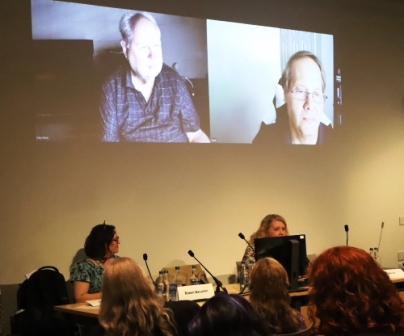
Panel with in-person and virtual panellists.
So what panels and talks did I get to and enjoy?
Dr. Tom Coughlin’s talk ‘Memories of Tomorrow’ covered both the history and future of data storage systems for computers and gave a fascinating insight into the latest technologies and what is down the road. As always, it is a balance between data capacity, physical size, reliability, longevity, and cost. Sounding similar, ‘Where’s My Tricorder’ proved to be quite an interesting discussion on taking measurements of all sorts.
Looking forward, ‘Sustainability - Fuelling The Future’ provided a very interesting discussion and had many points to make. For example: we have plenty of oil and know much more about finding it and extracting it, there is still a lot of coal left (though it is unacceptable to use it), and current batteries are very poor and we need much better battery technology (and we need to be prepared to wait for it because it is coming). Despite some people hailing it, hydrogen is a problem because it leaks like mad then combines with oxygen in the upper atmosphere to make water - and getting the ozone layer wet is a very bad idea. Oh, and it very easily catches fire so many houses will blow up.
The panel ‘Science Fiction as a Tool to Increase STEM Uptake?’ (Science, Technology, Engineering, and Medicine/Mathematics) was interesting; it was well lead and the panellists knew their subject and had interesting points to make. The excellent SFF (Science Fiction Foundation) Hay Lecture, ‘Life Extension in SF and Reality’, was enthusiastically given by William Bains; he was forthright, meaningful, and carried us along with his well structured talk. There should be more, many more, like that!
I also enjoyed the panels ‘From Whence Cometh The Next Pandemic’ and ‘Low Orbit Space Stations - What Does The Future Hold?’. I was touched at the ‘Christopher Priest Memorial’ panel as there were many tributes from his many friends and fans, including a summary by John Clute.
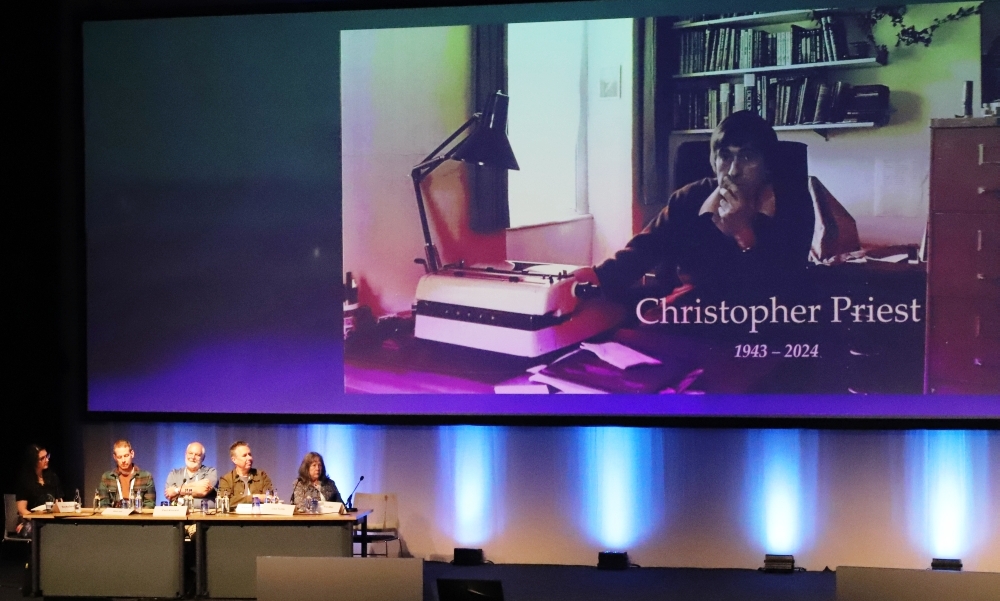
The Chris Priest memorial.
As a way of entertaining folks in the long queues waiting to get into programme items at the Dublin Worldcon(2019), they had the idea of conducting interviews with queue members for the amusement of all around, i.e. they asked some very silly questions. They repeated the idea this year and ‘The Queue Data Analysis Extravaganza’ was a most amusing presentation based on an analysis of the responses from these interviews. It was by its very nature off-the-cuff, unrehearsed, and ad-libbed; normally that would be a recipe for disaster but for this it worked a treat. It proved to be very funny! The idea is worth another visit!
There was a plethora of interesting-sounding items
but the problem was getting into them
That is not a long list of items to have attended, given that I was there for five whole days. I did attend more but often, as explained above, I gave up on them and went elsewhere. Reading through the programme schedule, there was a plethora of interesting-sounding items but the problem was getting into them – so many times there simply was not space in the rooms. I also wondered about some of the room allocations; for example, the popular item ‘30th Anniversary of Stargate’ was in a fairly small and completely stuffed room whereas the item in the much larger room next door was not that well attended. Why not put the two items in each other’s rooms? Probably because the other item was on the list of those to be shared with the virtual audience and therefore it had to be in the room with all the AV and broadcasting equipment, and that was the much larger room. Decisions do have to be made in advance and predicting what will prove to be more popular or less popular is not easy; personally I think that so often they simply needed a venue with more big rooms. If you are going to have a lot of attendees, you need a lot of room for them! Indeed, did the con have too many members for the space available? (Current Worldcon conrunners seem unaware that this issue has previously occurred, such as with the Dublin (2019) and the Helsinki Worldcon 2017.)
The First British Worldcon
not to have a film programme
I was surprised that there was no film programme! In Days of Old many SF films rarely came to your local cinema so cons were a good way of seeing them. These days those films are easy to find on DVD or downloads. Often Worldcon film programmes show rare, and often short, films, and often quite experimental. This was, I understand, the first British Worldcon not to have a film programme and that was a shame. Seattle in 2025 appears to have had a large one!
There were the large programme items, the big ones that many people wanted to attend, held in the Armadillo. The first of these was The Opening Ceremony and it went well. Con chair Esther MacCallum-Stewart ran it all very competently (presumably being a professor meant that she was very used to addressing large groups). She introduced folks such as the GoHs, performed a set of quick interviews, welcomed other guests (though without explaining why they were guests – cf. the lack of communications issue earlier), and the TAF (Trans-Atlantic Fan Fund) and GUFF (Get Up-and-over Fan Fund) delegates. She made announcements about First Fandom and the newly elected members and awards, ran the ‘In Memoriam’ video, introduced Chris Perkins from Wizards Of The Coast (makers of a D&D (Dungeons & Dragons) role playing game) and declared the convention open.
I noticed, though, that Esther sometimes slipped into using the ‘conference’ word rather than the ‘convention’ word – surely as CONVENTION chair she knew the difference? Mind you, there is a slight trend to use the ‘conference’ word – maybe people think that it adds more clout? Makes us seem more ‘mature’ or ‘serious’? More professional?
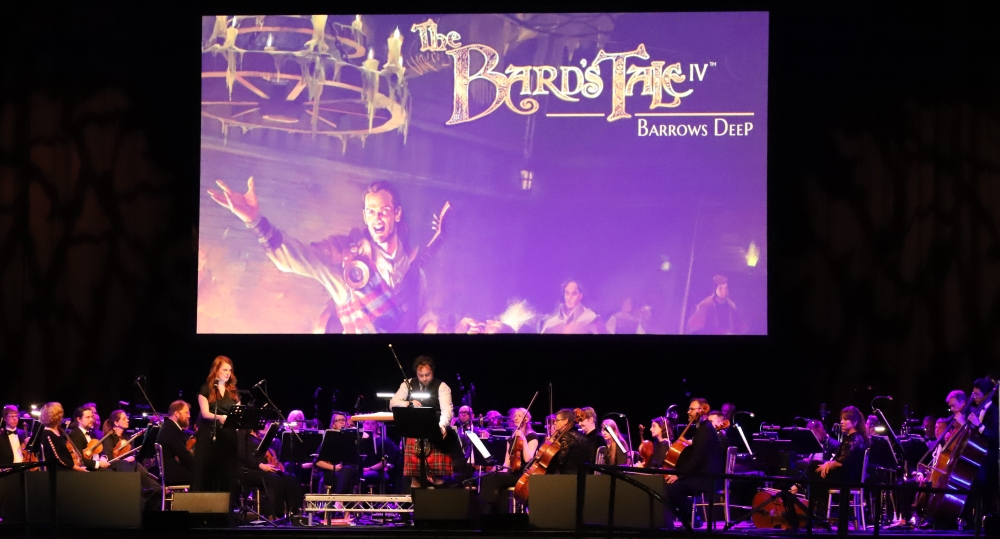
The Worldcon Philharmonic.
The Worldcon Philharmonic Orchestra provided an excellent performance. There is little so stirring as hearing a full orchestra of professional musicians playing some of your favourite music live, right in front of you - and they did not disappoint. As well as predictable pieces such as Also Sprach Zarathrustra and The Sorcerer’s Apprentice, and themes from Star Trek and Star Wars, etc., there were pieces of a more local nature with Orkney Wedding With Sunrise and The Hebrides (a.k.a. Fingal’s Cave Overture).
The Worldcon Philharmonic Orchestra
provided an excellent performance
The Masquerade was enjoyable and had getting on for thirty entries, many of them very good. Whilst the judges went off to deliberate, we were entertained by Sassafrass, an a cappella trio specialising in Nordic myths. They were good, though hear one sung tale of the ancients and you have heard them all.
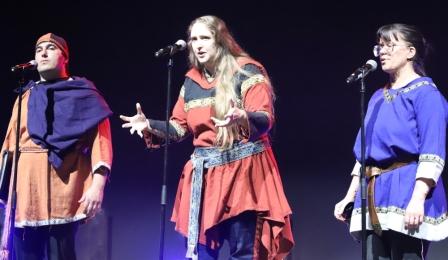
The Sassafrass cappella trio specialising in Nordic myths.
The Hugo Awards Ceremony went quite well though there were more technical glitches than there ought to have been. Not all the slides worked and neither did Catherine Heymans’ video (the 11th Astronomer Royal for Scotland, she was unable to get there), though Dr. Maganne Christian was able to read the script on her behalf. Details of the awards and their principal winners are available elsewhere.
Esther MacCallum-Stewart was again very good at the Closing Ceremony and it went quite well; it was certainly not the boring event that it so often is. She did the usual ‘thank you’s and, figuratively, passed the gavel onto the next year’s convention. The chair of the 2025 event should have been there to bang her own gavel and declare Seattle Worldcon 2025 open but she was stuck back at home following an accident and had sent a video instead. I was surprised, though, that Seattle did not have anyone there in person to at least wave to the crowds.
As well as the main programme items there were many other things to do. Hall 4 was home to the food and drinks trucks, which provided a good and surprisingly varied selection of quickly-served comestibles (not haute cuisine but certainly good enough) throughout the day and until into the later evening. There were plenty of tables at which to sit and eat and drink in the company of friends and fellow fans, and it soon proved to be one of the main social areas for the con. Incidentally, as well as at the Clydebuilt bar, food and drinks were also available from the deli/bakery shop and the convenience store, both in the main concourse.
The vast Hall 4 also provided an area for games playing, small lounge areas, space for fan parties in the evenings (rather than the normal room parties in hotels), a home for the book signing sessions, space for Terri Windling’s Dartmoor exhibition, and further exhibition space. There was a display of past Hugo awards, though it was not very obvious and was easily missed, and I did not notice the usual display of masquerade costumes (which at previous Worldcons have been impressive). Of particular note, and very popular, were a couple of Batmobiles; the classic one from the 1960s TV series (with Adam West) and the much newer, all-terrain version from the recent Christian Bale movies - both were photographed by nearly everyone!

The 1960s Batmobile

The 2010s Batmobile
Hall 5 housed the art exhibition and the dealers. I took several gentle wanders round the artwork, quite a lot of which was excellent, and ultimately failed in my intention of not buying anything this time (so yet more wall space needs to be found at home). As well as originals, there was a desk for buying prints, and they were doing a good trade. Most of the dealers were booksellers and again they were doing good trade. However, there were fewer of the other items I expected to see, such as T-shirts, costumes, fannish memorabilia/souvenirs, DVDs, and so on. Usually the Dealers’ Room at a Worldcon has a plethora of different goodies on offer.
The art exhibition artwork,
quite a lot of which was excellent
In the past I have enjoyed meeting writers, etc., and their other fans in small, organised get-togethers round a table and under the names of Kaffeeklatsch (from the German, literally ‘coffee chat’ or ‘coffee gossip’) and its alcoholic equivalent, Literary Beers. I thought both names quite suitable but now, since Chicon 8 in 2022 I discovered, they are called Table Talks. I know it is a bit pedantic but, depending how you choose to interpret it, the tables do not talk and neither are talks given at the tables – it is a general chat and discussion. Kaffeeklatsch – a good natter over a coffee or whatever – seemed such an appropriate name for what happens that I am flummoxed as to why anyone thought it needed changing. Change for the sake of change? Inability to spell Kaffeeklatsch?
In the past you simply signed up for one at the Information Desk and when the list was full, it was full (with maybe a spare or two in case of no-shows). The staff at the desk would endeavour to ensure that greedy folks did not hog the whole lot, and it always seemed to work. Now, of course, it had been automated and you had to apply online the day before, all the names went into a hat and the ‘winners’ were selected. You had to wait and hope you received (and also hoped it got through!) an email saying you were successful. This not-knowing-until-much-later approach did not seem an improvement to me – you could have made plans assuming you would be unlucky only to find at the relatively last moment that you had to change your plans because it now turned out that you were lucky. I wonder how many no-shows that lead to? Furthermore, whilst most people carry the technology (smartphones, etc.) to use such applications, not everyone does. I was assured that you could apply in person at the Information Desk, which actually meant that they applied online on your behalf, but, as with much else, the Information Desk was unaware of this, at least to start with. And, of course, if you were lucky you needed a way of receiving that email or else you had to hope that the Information Desk would actually have the answer when you personally went to ask them. By the time they had learnt that it was in fact one of their duties, I had given up trying. I never did get to attend one, which was a shame, especially when a friend pointed out that the table talk she hosted had been under populated (and I suspect that possibly others had as well).
There was a good Filk stream, with panels and concerts and then circles in the later evening. Whenever I popped my head round the door it was going well, though usually full, and thus I never did manage to get into any of the concerts, only the circles.
Whilst many made use of the Clydebuilt bar in the SEC Centre, it was worth the minute’s walk to the fan bar, the Fan And Fishlifter, which had been opened for the duration of the con in the Argyll Foyer of the Crowne Plaza. This had real ales from the nearby Kelburn Brewery, at a more sensible (though still pricey) £6.50 (US$8.60) a pint, and they offered a good selection of beers and beer styles (it was almost a mini beer festival). The only ‘problem’ was that they kept running out of ‘this’ and you had to move on to ‘that’, but they were all excellent. It was, of course, also a good place to find people and socialise. It was open from 11 am most days until the following 2 am.
CoVID, Masks, and Clear Speech
CoVID was, of course, a concern and with their Disease Mitigation Policy the con understandably asked people to test before travelling and to stay at home if they were positive. Indeed, they asked that you stayed home if you had anything communicable; after all, nobody wanted whatever form of con crud you were suffering from. However, the con also asked everyone to test for flu, which was an interesting request given that flu tests are not readily available; as my pharmacy explained, the only way I could get a flu test was for me to persuade my doctor to send me to the hospital for one. In forming their health policy, did the con not know that flu tests were not generally available? In which case, what else did they not really understand?
The con correctly made it clear that mask wearing was optional and that everyone should respect everyone-else’s decisions without comment. However, several con reports I read online complained that the con was not insisting on masks and one person even accused the con of not enforcing mask wearing, apparently unaware that to do so would be illegal. As far as the government was concerned, the CoVID-19 pandemic was over and mask wearing in public ceased to be mandatory a few years ago! One report estimated that about 20% of the members wore masks, which jars with my recollection that hardly anybody did. I checked my photos and masks were indeed difficult to spot. Interestingly, apart from a couple from Japan, every mask I came across had an American accent behind it, leaving me wondering if the insistence on mask wearing was an almost purely American thing. And that leads to the question of whether American fans should accept that we should simply learn to live with CoVID, as we do with other diseases, and as expected to by our governments.
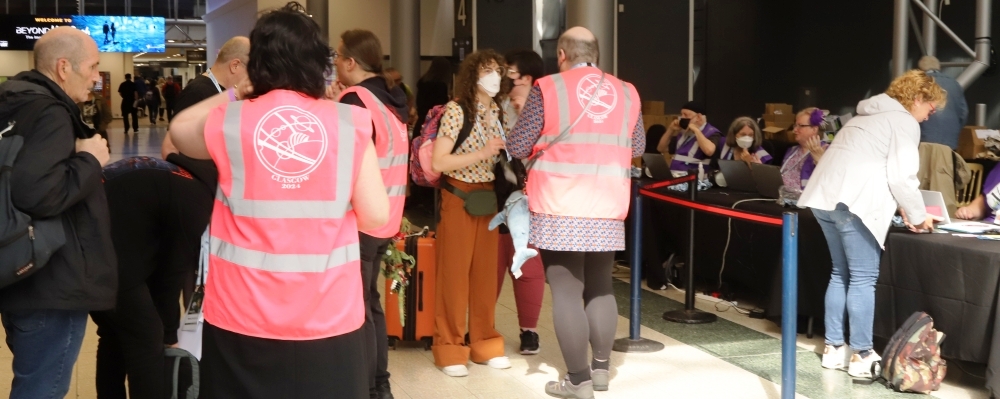
There were a few wearing masks
Those who wore masks on panels seemed unaware of just how much they got in the way of being understood. If you are worried about diseases, and that is quite fair, none the less remember that you did not have to be on the panel, you volunteered to be on the panel, and you OWE IT to the audience to be heard. One masked lady muttered so quietly that another panellist almost jammed a microphone though her mask, several times – and she still did nothing about it. Shame on her! If what she had to say was so important to her that she wanted to be on a panel to say it then surely she wanted people to actually be able to hear what she had to say? All panellists - speak up, speak clearly, and be heard – OR stay off panels!
One thing that got me at the Hugo awards Ceremony (and afterwards others also commented negatively on) was that a few, all of whom seemed to be American, of the winners or their representatives made their acceptance speeches with masks on. I accept that they were worried about infections but is it really asking too much of them to remove their masks just while at the microphone, with nobody close to them, so that we could see them AND hear them clearly? Is that not just plain courtesy? After all, even government officials (mentioning no particular Prime Ministers or Health Secretaries) did so when addressing the nation during the pandemic. And music artists would hang their masks on the microphone stands when performing. Did these folks really have a problem or were they trying to make a (frankly pointless) point? I particularly noticed T. Kingfisher (Ursula Vernon) in this category; there was just something about the way she wore her mask almost aggressively. She stood at the microphone, with nobody anywhere near her, and gave a very entertaining talk on sea cucumbers as part of her acceptance speech for her Hugo Award for Best Novella; she spoke long enough, and far enough away from anybody else, that she had no need to keep her mask on. She would have been easier to hear without it, but it stayed and stayed and stayed. Such disregard for the audience!
Theses days I wonder if conventions should insist “wear a mask if you want to – but it MUST be removed when speaking publicly”.
Publications and Communication, and the Accessibility and Information Desks
As explained to me by the area head of Team Info, since the beginning the convention had a policy of sustainability (and that is a Good Thing) and this included not using paper if it could possibly help it, from which it follows that everything should be online (or online as well) if possible. He implied that paper documents were ‘single-use’ (hardly true given the number of times I have referred to the Convention Guide and Newsletters) and ‘the largest contributor to non-reusable waste’. I am not sure what non-reusable waste is as, by definition, if it was reusable it would not be waste and, likewise, waste is non-reusable (else it would be ‘recyclable’). Thus it seems an odd claim as paper is well known as being very recyclable (as my local Council’s Recycling Team keeps reminding me).
However, I wonder if the con took account of the environmental cost of cloud storage, server farms, network usage of frequent downloading of documents, and so on. To quote a report from the MIT Reader ‘… the Cloud now has a greater carbon footprint than the airline industry. A single data centre can consume the equivalent electricity of 50,000 homes.…’. The International Energy Agency estimates that a typical AI-focused data centre uses the same power as 100,000 homes! Online services require a lot of power and come with a high environmental cost; this should be taken into account and reducing that cost should also be part of sustainability aims.
I realise that most people, perhaps especially SF fans, make great use online services such as the Internet, email, and smartphones. To many people, doing everything on a smartphone seems to be all they know BUT not everybody has a smartphone and some people are unable use a smartphone. And, of course, there are people who choose not to use a smartphone for a variety of their own reasons. The convention had a policy of inclusiveness so it should therefore include members who do not have, or do not want to use, a smartphone - members that rely on the use of paper.
I raised the problem of those who still relied on paper with the con chair in advance of the event and she assured me that suitable provision would be made and, indeed, was planned for. The Accessibility and Information Desks (which were next to each other and pretty much merged) would have everything we needed on paper, we just had to go there and ask for it. No questions would be asked and nobody would need to justify their request. Unfortunately, that message had not got to all the staff on said desks, some of whom went so far as to deny it whilst others just said that they ‘did not know about such things’. Throughout the convention they were reluctant to hand out anything on paper, despite the promises made by the chair, and this cast a certain amount of doubt on the claimed inclusivity.
The six Progress Reports (PRs) were available only as downloadable PDFs. Apart from PR0, they all had Tables of Contents which, had they been on paper, meant that you could quickly flip through the pages to the ones you wanted. The online equivalent is to hyperlink the ToC but this was only done for PR3 and PR5. Incidentally, the downloadable version of the Souvenir Book also failed to use hyperlinking. I mentioned the use of hyperlinking to Publications and was told that they would ‘decide it it’s something they want to include’ – surely it should have been an obvious standard feature for electronic documents?
The Convention Guide was, of course, an online document. It was made available on the website as a PDF and could be downloaded at home and printed before the event. I enquired whether printed copies would be available at the con and was assured that they would, and indeed that was the case, though to start with the Accessibility and Information Desks denied it. Then they admitted it but were very reluctant to hand them out, resulting in me having to demand one and pointing out the con chair’s guarantee.
The printed Convention Guide was a nice looking document but, being A5 size, a little too large to fit in the back pocket of my jeans (whereas some past Convention Guides have been designed to do so for the sake of convenience). However, the chosen font size was very small and difficult to read, especially so in poor light. The font itself was so thin that, at that size, it appeared to be grey rather than black (maybe it was grey?), which made reading it even more difficult. They should have seen that for themselves as soon as they printed their first proof copy. It struck me that anyone who had visual problems, even as simple as poor eyesight, had been let down. Fortunately I had printed out a copy at home, at A4 size, and this was large enough to read easily, though it meant lugging an A4 ring binder around with me.
The online version was, I was told, good and quite easy to use and the ability to search the programme was well done and appreciated (though that might have been a separate system). At the 2018 Worldcon in San Jose, I tried both the online system (on my iPad) and the paper version and found the paper version preferable and more flexible. In particular, I could write on it – circle items, write comments and notes, draw arrows, and even differentiate using pens of different colours. I took my iPad this time, again hoping to use it in conjunction with my printed copy of the Guide, but I hit a problem. Mine is Wi-Fi-only but would not connect over the SEC’s Wi-Fi, though it did warn me that the SEC’s Wi-Fi was insecure. Following general security advice, I use a VPN when in public places and the SEC later confirmed that they use a VPN blocker – ‘With regards to the wi-fi, there is a VPN blocker on this for safety and security reasons’. Hmmm – whose security? To use their Wi-Fi meant switching off my security! Was the committee unaware that they were expecting members to connect over Wi-Fi on a site which prohibits a more secure connection? It seems remiss of them to insist that their members use online services whilst in a building that does not allow users to protect themselves. Another ‘have they thought this through’ moment.
After a while I found people were asking me where I got the printed Convention Guide from as they had given up on the online version/system, a frequent complaint being that the download times could be extremely long. Someone told me their phone showed an estimated download time of two and half hours for one of the PRs they wanted to check, so that gives you an idea of just how slow accessing information could be. By the end of the con, I saw folks all over the place with printed Guides in their hands and I did hear a rumour (unsubstantiated!) that they ran out of Convention Guides and had to get more printed – which I think, IF true, proved a point or two.
There was a problem with the site maps in the printed Guide and a bunch of rooms were missing. The Information Desk had a plan showing these rooms but, typically unhelpfully, they refused to print copies of it - you had to photograph it on your smartphone. Of course, if you had a smartphone and therefore the online copy then you were OK anyway as that version showed the missing rooms. Catch 22 – if you were confined to paper then you had to take a photograph, but if you could take a photograph you did not need to! But even then, as somebody demonstrated to me, the PDF format used in the Guide was not scalable so zooming in on your smartphone screen simply blew up the fuzzy map, making it bigger but more fuzzy and still unreadable.
I was told before the event that a programme grid would be produced and a printed copy available at the Accessibility and Information Desks for those that asked, though I never saw one and they denied it. I do not know when it was published to the website (certainly it was not until after my last pre-con trawl round the website) but one was eventually available online and it ran to 18 useful pages – it is a shame I was unable to find one at the con because I would have found it very useful. Once again, I wondered about an Information Desk which did not provide necessary information.

Glasgow 2024's newsletter was The Unicorn.
I always enjoy the con newsletter, usually produced a couple of times a day plus specials, but this year’s was an exception. It was called The Unicorn and, apart from the special issues, it contained little more than constant reminders about getting to places on time, not overcrowding rooms, and bag searches. There was none of the usual news, gossip, and interesting tidbits that add to the ambience of a con as you sit and read it during a coffee break. I assume that such things were now only on Discord – once again, not seen by those without smartphones. Indeed, is this the reason why every programme item seemed to have half the audience on their smartphone screens all the time? Unicorn #7 showed a photo of ‘A man holding a dragon’ but failed to mention that he was Joe Siclari, chair of Magicon, the 1990 Worldcon in Orlando. It seems that being a past Worldcon chair buys you little fame these days, even in a Worldcon newsletter.
I was assured that printed copies of the Newsletters could be obtained but, again, the Accessibility and Information Desks sometimes denied it. At one point, when specifically asked, the Information Desk refused to print a copy for myself and another member (who was wearing a staff tabard!) so that we could read them over a coffee. He said that if we really wanted them on paper then we should print them at home. Think about that – a return drive to the airport, two hours of flying, then over four hours of driving – hardly environmentally friendly! And a whole day of the con lost just for a newsletter! I pointed out that there were several printers right behind him so it could not be difficult to print off a couple of copies but he assured me that nobody knew how to make then work. Really? On Day Four? I offered to go and get the techies from the Operations Team next door to sort this out for him. Seeing that we were absolutely insisting that he met his obligations and we were not going away, suddenly he tapped a few keys on his laptop and a printer sprang into life. Of course he knew how to use the printers! I do not wish to call him a liar, but it does seem an appropriate word. Perhaps I am living in the past, but at an SF Convention I expect honesty between fans!
And a word of guidance for those worried about using paper – print on both sides! Often information, Newsletters, etc., from the Information Desk was printed single-sided. If they really were that worried about using paper then surely they would have ensured that all their printers were set to double-sided, but they did not!
This year there was no Restaurant Guide, the first Worldcon I have attended without one. Did the con rely on social media?
The Souvenir Book was a nice piece of work though both the printed and online versions had a few typos and errors, though not always the same ones. The typo everyone noticed was ‘Scottland’ on the front cover of the printed version. Ooops!

The printed version was available only by personal collection at the event. No alternatives. Even attending members who were unable to get there and offered to pay the postage did not get one. When I queried this, quoting such reasons as cancelling attendance due to CoVID or other diseases (as requested to do by the con’s Disease Mitigation Policy!), Publications replied to my points that they did not deal with ‘hypothetical situations’. CoVID was now merely hypothetical? Having to cancel for any reason was hypothetical? The convention being able to put a copy in the post if the (unable to attend) attending member paid the postage was hypothetical? I think they just did not want to, and that says little for the committee.
If you wanted to collect your Souvenir Book you had to hunt for it - it was not given to you at Registration. All Registration gave you was your badge - gone were the days of a tote bag with your badge, Convention Guide, Souvenir Book, various leaflets, and sometimes even a spare paperback or two. Admittedly the Souvenir Books were on a table behind Registration, but the folks there often forgot to tell you that (and some of them did not even seem to know) – you had to either ask or spot them for yourselves.
Rob Jackson, in Inca no. 25 (December 2024), reported ‘Despite a membership of 8,000, only 5,000 were printed on the assumption that not everyone would want to pick theirs up. This was even more true than the committee thought, and only 4,200 went – sadly 800 were recycled after the con.’
This is hardly fair. As I have explained, they did not give you your Souvenir Book, you had to find it. Whilst easy to find (assuming they always had their stocks on display and made sure that they had not run out), none the less many people did not spot them and I had a number of people ask where I had got mine from, and I found myself having to point them to the location (as I had to with the printed Convention Guides). Given that many people only discovered after the event that the Souvenir Books existed and that they ought to have collected them, and there were attending members who were unable to attend and the convention refused to post them even if requested, I would say that having a mere 800 left after the con proved how popular they were. If there were any left over, was it not the con’s fault for failing to distribute them? I thought their policy was awful and to be ashamed of.
Their publications policy was awful
and to be ashamed of
At the very end of the con, there were piles of Convention Guides and Souvenir Books on a table in the main concourse, along with ‘Please take’ signs, to avoid them being recycled. But it was only then, at the very end of the event, that they were made obvious. Why only then?
George R. R. Martin. It was covered in the national press, who might have been short of good stories it being mid-summer, but George R. R. Martin reported severe problems communicating with the con. In advance of the event, he had casually dropped them a line to see if he could help in any way and to discuss some ideas he had, only to be informed that anyone, but anyone, wishing to participate in any form in the programme could ONLY do so by applying online to be a programme participant. Squeezing answers out of the Internet can be difficult but this also looks to be something that was started by Chicon 8 in 2022. At that point he just wanted a friendly chat, which seems very reasonable. However, the con, or at least Programming, was adamant - applying online via a form was the ONLY way to communicate with them on programme matters. As a past Worldcon GoH and also a Hugo winner, who you would have thought the con would wish to welcome, he felt slighted and that con's reaction was over the top. He was not inclined to play such games. And so he played no part in the programme at all. He was present at the con (according to photographs) but it was the first time I have been to con where he was there but I never saw him.
Robert Silverberg, also a past Worldcon GoH and Hugo winner, was equally invisible; again this was the only time I have been to con where he was present but I never saw him. I do not know if he too had problems with the communications attitude of the con – but I find it strange that two such Worldcon stalwarts, past Worldcon GoHs at that, were completely missing from anything official at the convention. Why? Shame on the con?
Other Odds
It was possible to watch some of the convention, items that had been, or partly been, virtual and also recorded, up until Christmas. I had intended to try this facility but, life being busy, I never got round to trying it in time. I did get as far as creating some kind of account, though that had to be done before the con itself had closed and seemed unnecessarily complicated. Whether it worked well or not I cannot say. It was an interesting idea, though, but a shame it timed out.
Conventions sometimes do interesting things connected to their locality. This con created its own tartan, Landing Zone Glasgow, which was a nice idea (and a nice design). Unfortunately but not surprisingly I found most of the tartan merchandise quite expensive – though it did look to be of good quality. Tailor-made tartan gear does not come cheap!
The con developed its own gin, by the name of ‘GIn2024’ (Glasgow In 2024?). Perhaps that says something about the current craze for gin. I do not associate gin with Scotland in particular though I very much associate malt whiskey with the country and I would have thought that having their own whiskey would have been more Scottish. Perhaps preparing a good single malt was a task that would have needed to be started years ago, but as the Clydeside Distillery was at the other end of the SEC car park, I would have thought they could have come up with something.
Final Thoughts
Having looked back on the event as I wrote this, consulted my notes from the time, and taking account of all the problems and weaknesses I personally came across, I wonder if, from my experiences and perspective, ‘three to four’ out of 10 was a little generous when comparing it with those previous Worldcons I have enjoyed.
A three to four out of ten convention was a little generous
when comparing it with those previous Worldcons I have enjoyed
‘Could have done better’ seems a bit weak. Yes, it was good to go to a Worldcon, meet up with old friends, and enjoy some (but only a very few) of the nearly one thousand programme items, but all told this was to me probably the most disappointing Worldcon I have attended. And Intersection in 1995, on the same site, still shines in my memory – ah, that one was fun!
Back in 1995, Intersection had 6,524 members, of whom 4,173 were attending (Wikipedia’s figures). Since then the venue site has expanded and has greater capacity but Glasgow 2025 had 75% more attending members and it was too many, at least for the sizes of rooms. This seems to be a problem of late; London (2014), Helsinki (2017), and Dublin (2019), were noted for inadequate room space and Glasgow 2024 is now also on that list. It is a problem for future Worldcons to figure out – find venues with lots of large rooms … or have fewer members? But SF² Concatenation has noted this before! Time will tell.
Peter Tyers
Other coverage of the 2024 Glasgow Worldcon, elsewhere on this site, includes:
- There's just one bid for the 2024 Worldcon – Great Britain
- Britain's 2024 Worldcon bid has been formally launched
- Glasgow is the proposed venue for Britain's 2024 Worldcon bid
- The Glasgow bid is still on but overcrowding is not being addressed
- Glasgow is still the sole bid for the 2024 Worldcon
- Glasgow 2024 is now officially an unopposed Worldcon bid
- Glasgow wins the site selection vote for the 2024 Worldcon
- Fake 2022 and 2024 Worldcon merch on sale
- What special Hugo Award category for 2024? (Editorial)
- Glasgow Progress Report 1 now out
- There's a need for WSFS governance motions at the 2024 business meeting. (Editorial)
- Glasgow Progress Report 2 now out
- Glasgow delays virtual membership price rise
- Glasgow's one-year countdown announcement
- Are Worldcons becoming unfannish: Glasgow ignores WSFS rules. (Editorial)
- Glasgow replies to SMOF questionnaire
- Glasgow releases disease mitigation policy
- Glasgow has new guest – T. (Tendai) L. Huchu
- Worldcon publications policy. (Standalone article)
- WSFS desperately needs an overhaul at Glasgow 2024. (Editorial)
- Scotland's Astronomer Royal Glasgow's virtual guest
- Glasgow Progress Report 4 now out
- Glasgow 2024 has new registration rates
- Glasgow Chair effectively confirms abandonment of WSFS publication rules
- Mark Yon's virtual Glasgow Worldcon report
- Steven French's virtual Glasgow Worldcon report
- Tim Atkinson's physical Glasgow Worldcon report
- Worldcon publications policy
- Glasgow: An introduction for visiting SF folk
- The 2024 Glasgow Worldcon has been held
- The Glasgow Worldcon Science Programme
- The Glasgow Worldcon Business Meeting
[Up: Convention Reviews Index | Home Page: Science Fact & Science Fiction Concatenation]
[Article Index | Recent Site Additions | Most recent Seasonal Science Fiction News]